9 Things, India!
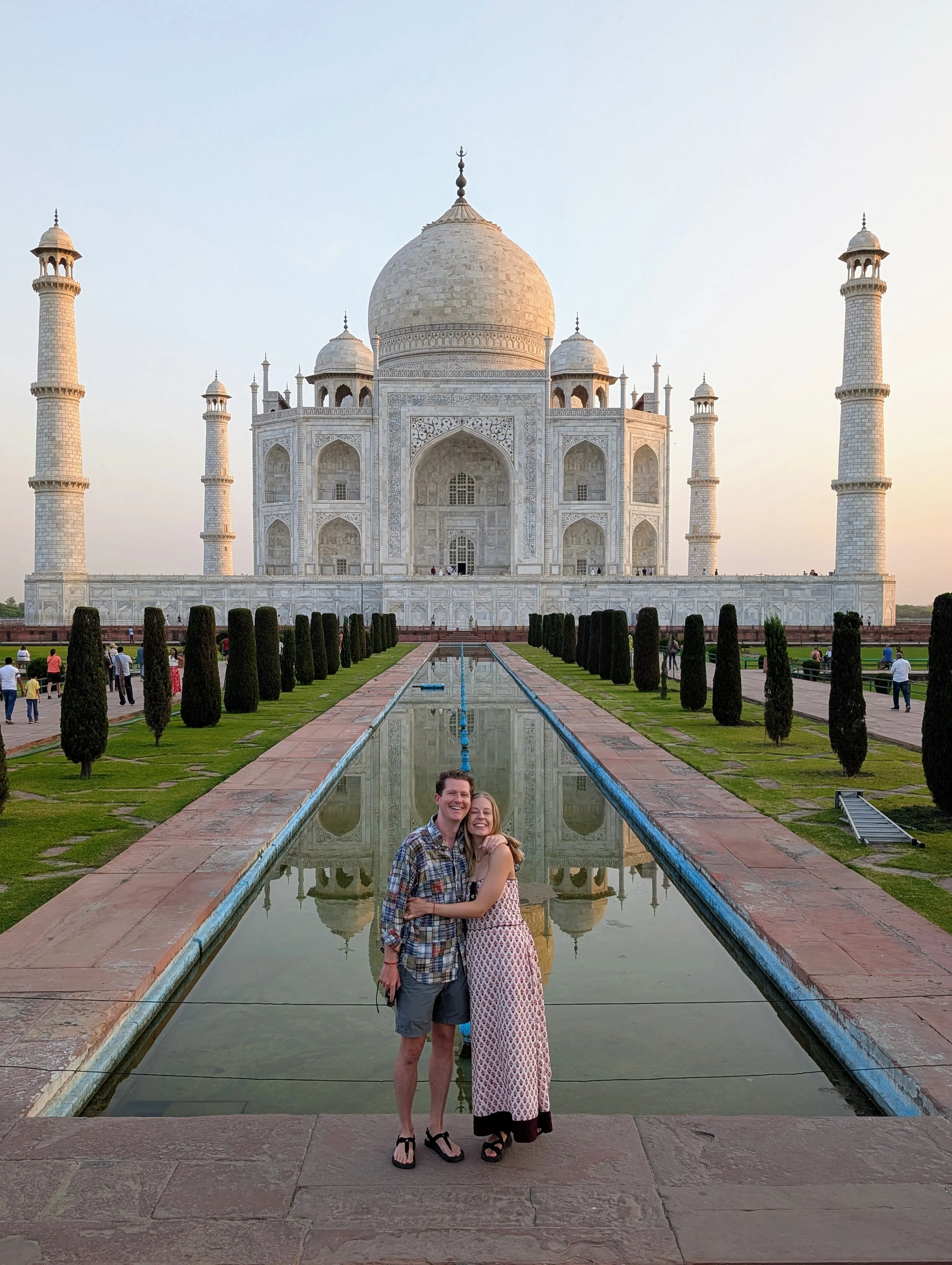
Makeda and I spent the month of April traveling in northern India. We were primarily in the state of Rajasthan, but also visited Agra and Varanasi in Uttar Pradesh, as well as Rishikesh in the foothills of the Himalayas. It was both of our first time visiting India, and it was unlike anything or anywhere we have been before. We were absolutely invigorated by our time there, and are so glad that we included it on our journey. I am hoping to write a few posts on our experiences, but to start, here is another “X Things” post, featuring Makeda’s inaugural contribution to the blog!
1. Food (Paul)
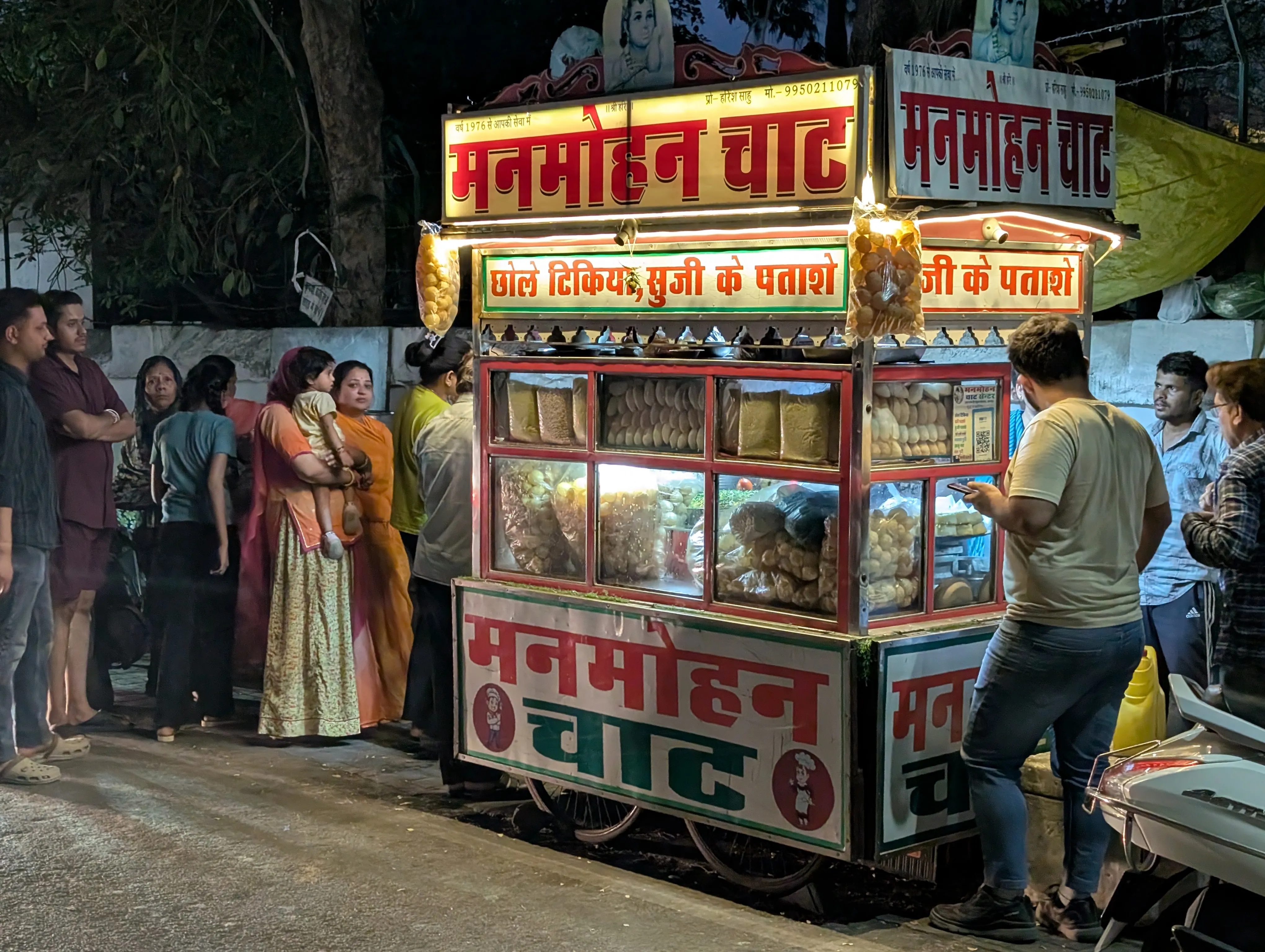
Makeda and I enjoy periodically power-ranking our five most commonly eaten Asian cuisines: Chinese, Japanese, Korean, Thai, and Vietnamese. Often we pose this question to friends and family over meals, and after painstakingly settling on a list, we like to throw Indian food into the mix. Naturally, we have been revisiting our rankings after passing through each country, and India was no exception. I have always ranked Indian food quite high, but after experiencing Indian food in India, it has solidified itself at or near the top of my list. The food is almost miraculous. The sheer amount of flavor in each bite is unbelievable, and felt analogous to India itself: spicy, rich, complex, intense, plentiful, and sometimes known to come back to bite you.
There was a lot of food that we recognized from Indian restaurants in the United States (tikka masala, butter chicken, naan, etc.), but we found plenty of new dishes to discover as well. In Jaipur we went on a street food tour where we tried aloo kachori, imarti, pav bhaji, tandoori paneer, pani puri, soya chaap, masala dosa, ghewar, and local ice cream. The pav bhaji and tandoori paneer were standouts. Across Rajasthan we frequently ate thali - traditional meals served on a large platter with multiple small bowls (katori) filled with various dishes and either roti, paratha, or naan to sop everything up. One thali highlight was at Mohan Restaurant in the Bapu Bazaar in Jaipur, a hole-in-the-wall spot with the best lachha paratha we had all trip. In Udaipur we met a friendly Indian couple while watching the sunset at the ghat who insisted we try dal baati churma, an iconic Rajasthani dish. It consists of baatis, which are dense unleaved bread balls, that you cover with rich dal and smash into a chunky paste with your fingers. Our server noticed our confusion and took the liberty of smashing our baati himself. He then generously ladled hot melted ghee over the entire mixture. It was delicious, but needless to say we went into food coma for the rest of the afternoon.
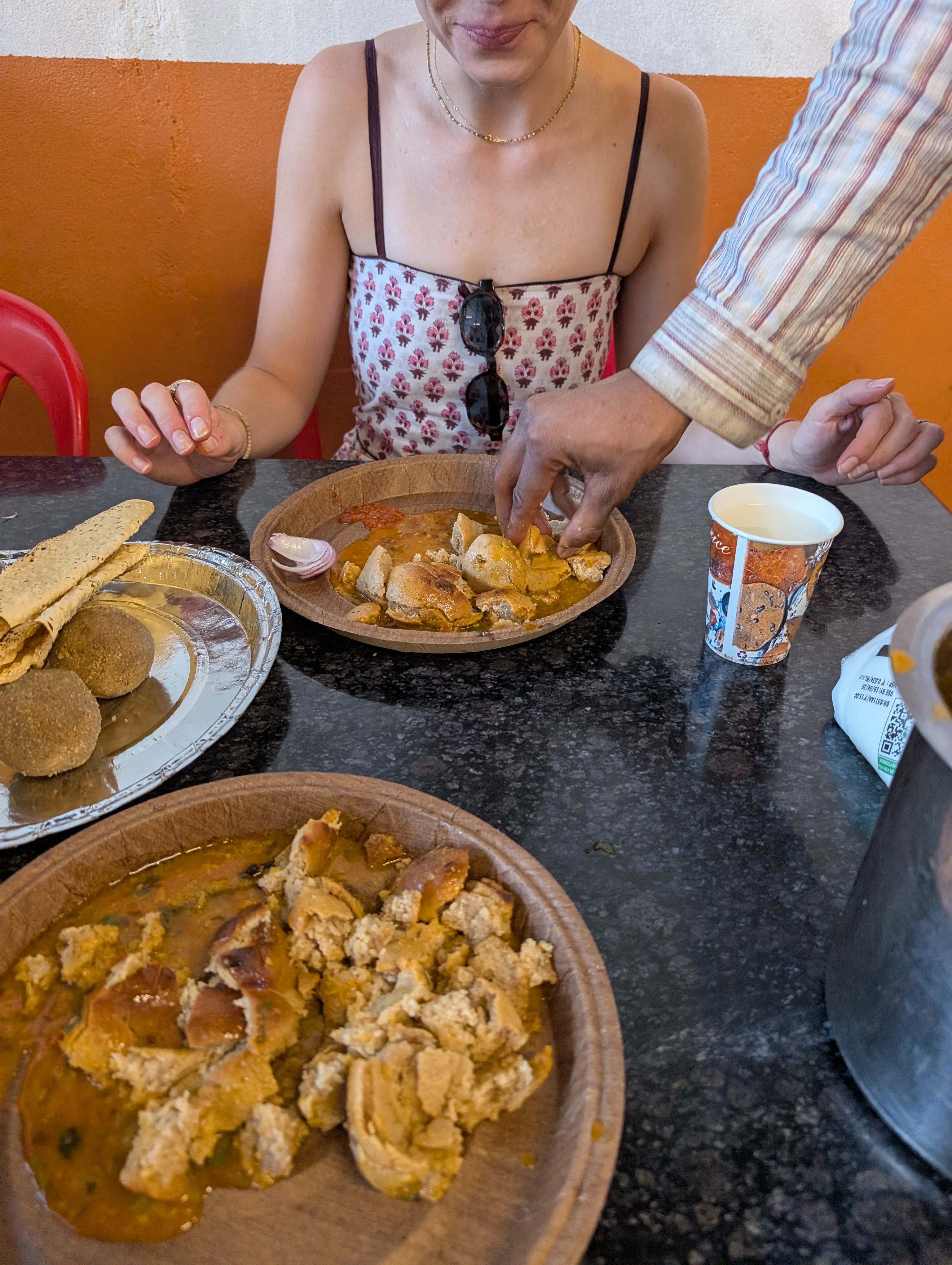 Our server smashing Makeda’s baati.
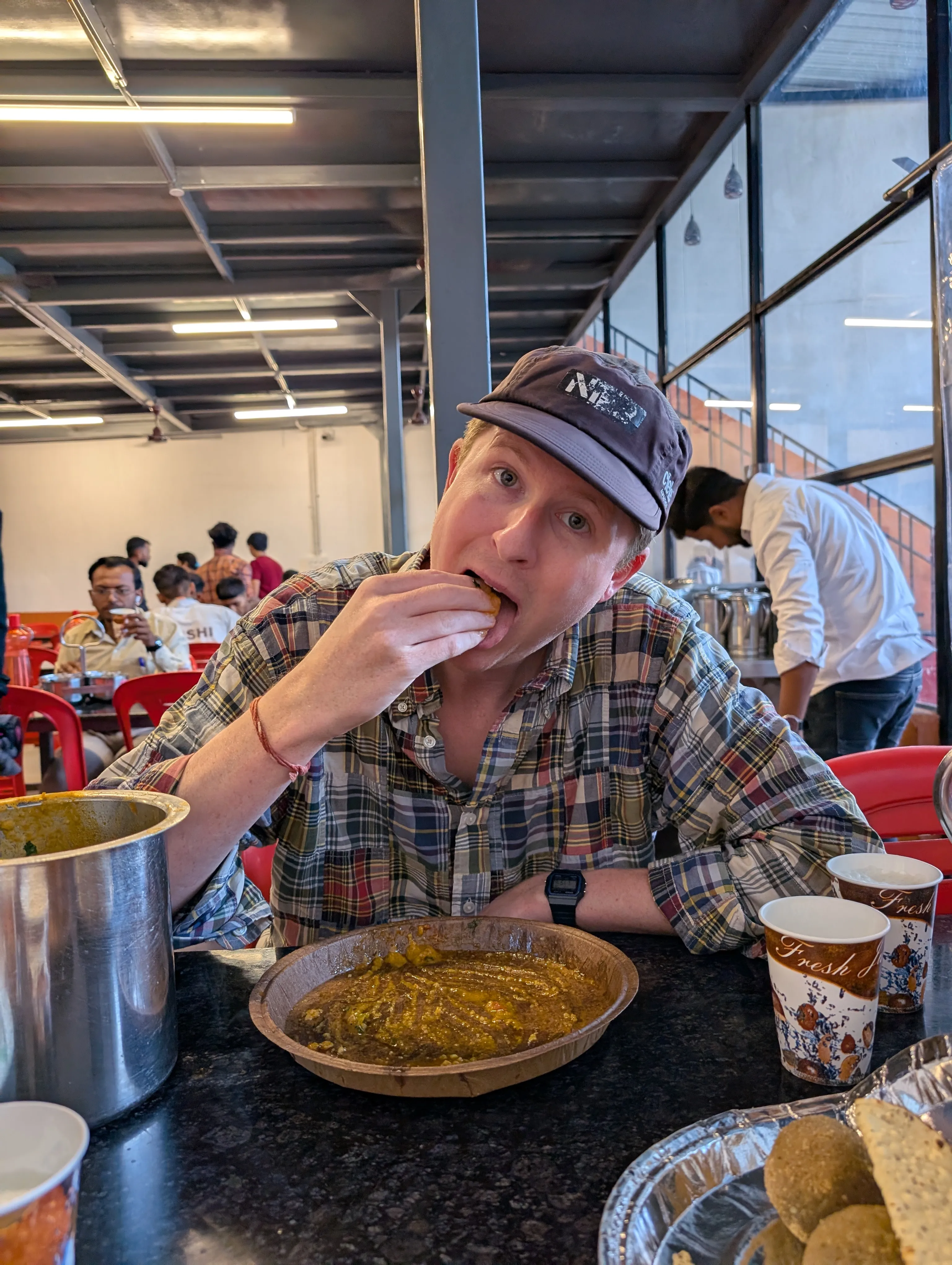 Clean plate club.
Personally, the best food I had in India was in Sawai Madhopur at an open-air food court near our hotel. One of the stalls served up hot and fresh north Indian classics, including the best butter paneer tikka masala I have ever had. Another stall hawked the best mango lassi I have ever had, too: thick, ice cold, sweet but not too sweet, with a delightful topping of slivered almonds and raisins. The food here was so good that even after Makeda came down with a stomach bug, I went back multiple times.
Alongside the north Indian classics we ate our fair share of south Indian food, too. Rice flour dosas and idlis were a nice respite from the comparatively heavy bread and curry cuisine of Rajasthan. And although we are relaxing our pescatarianism on this trip, we did not eat any meat at all in India, as most restaurants are entirely vegetarian. The biggest culinary negative we experienced in India was the general lack of fresh vegetables, which is not to say that they do not exist (although they are certainly not central to the cuisine), but rather that we avoided them to prevent stomach issues. For the most part, we succeeded.
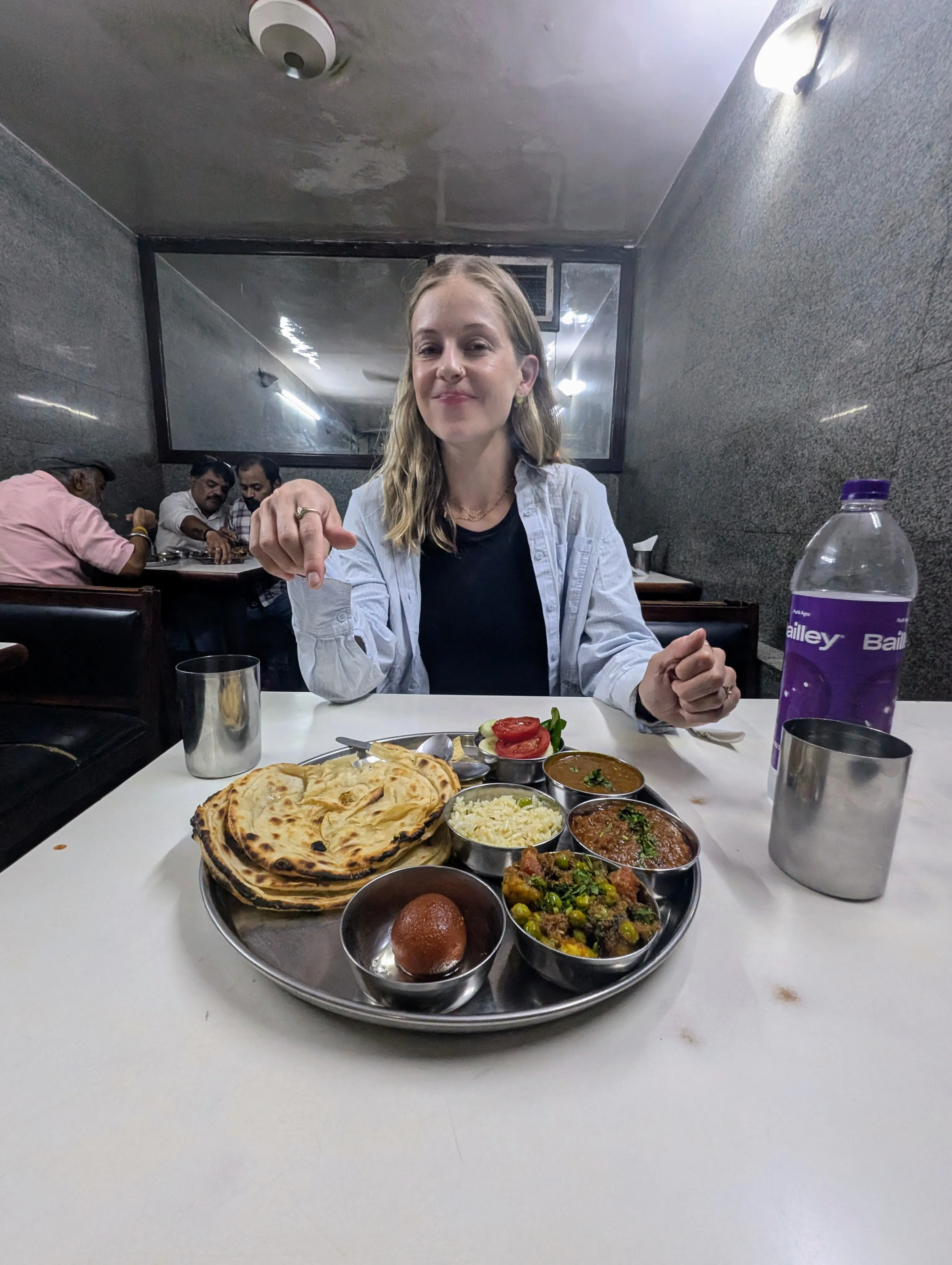
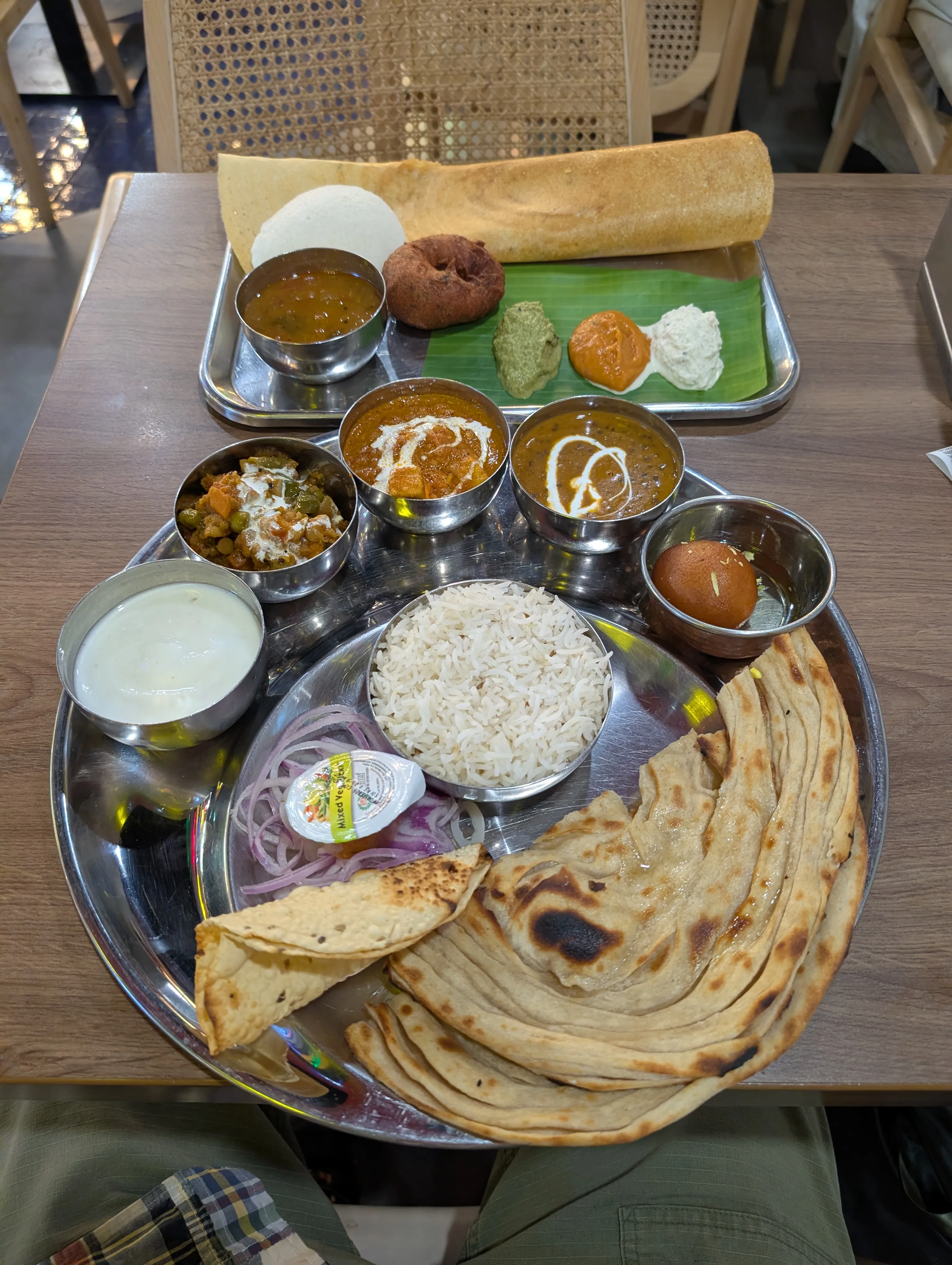
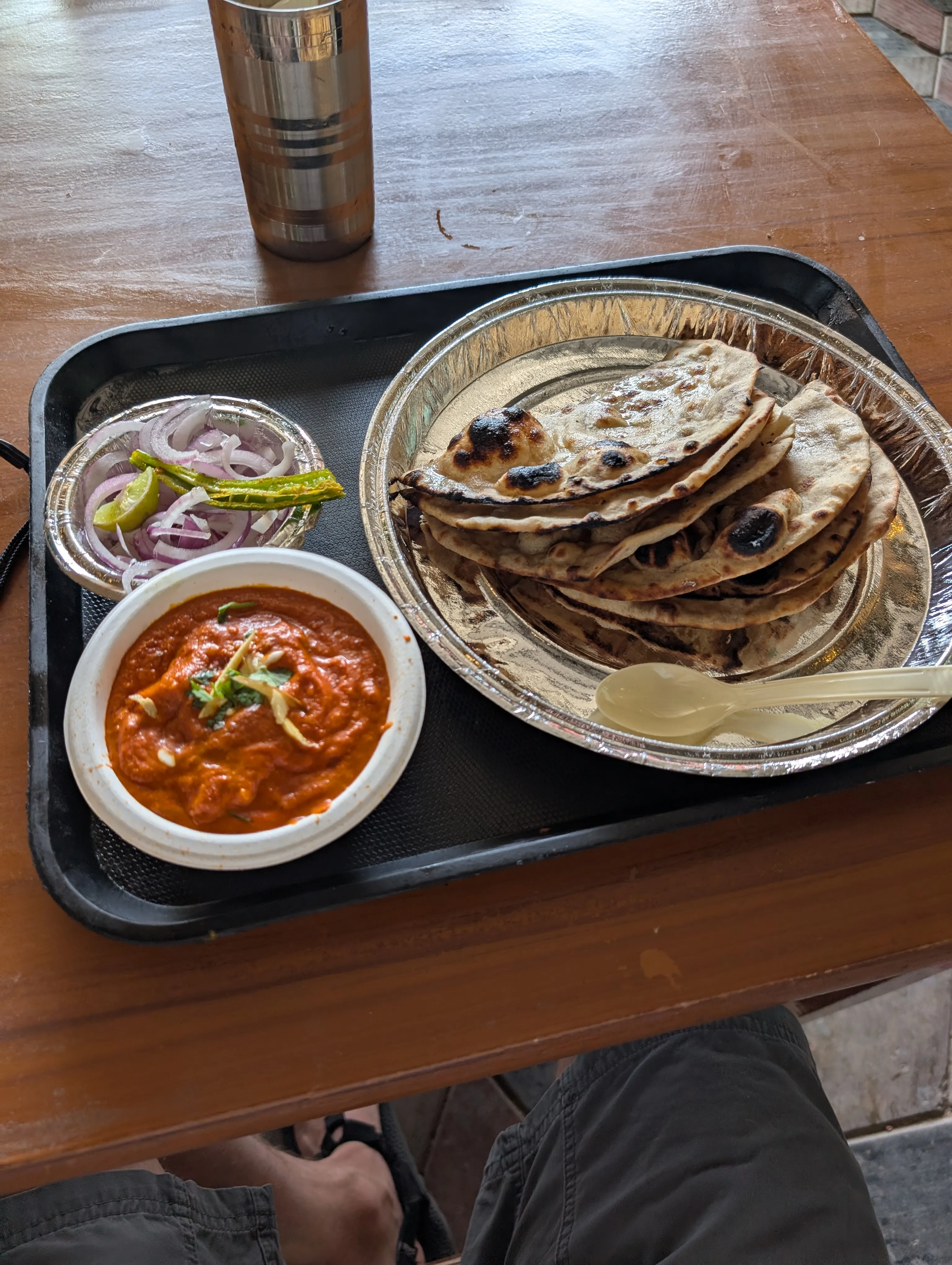
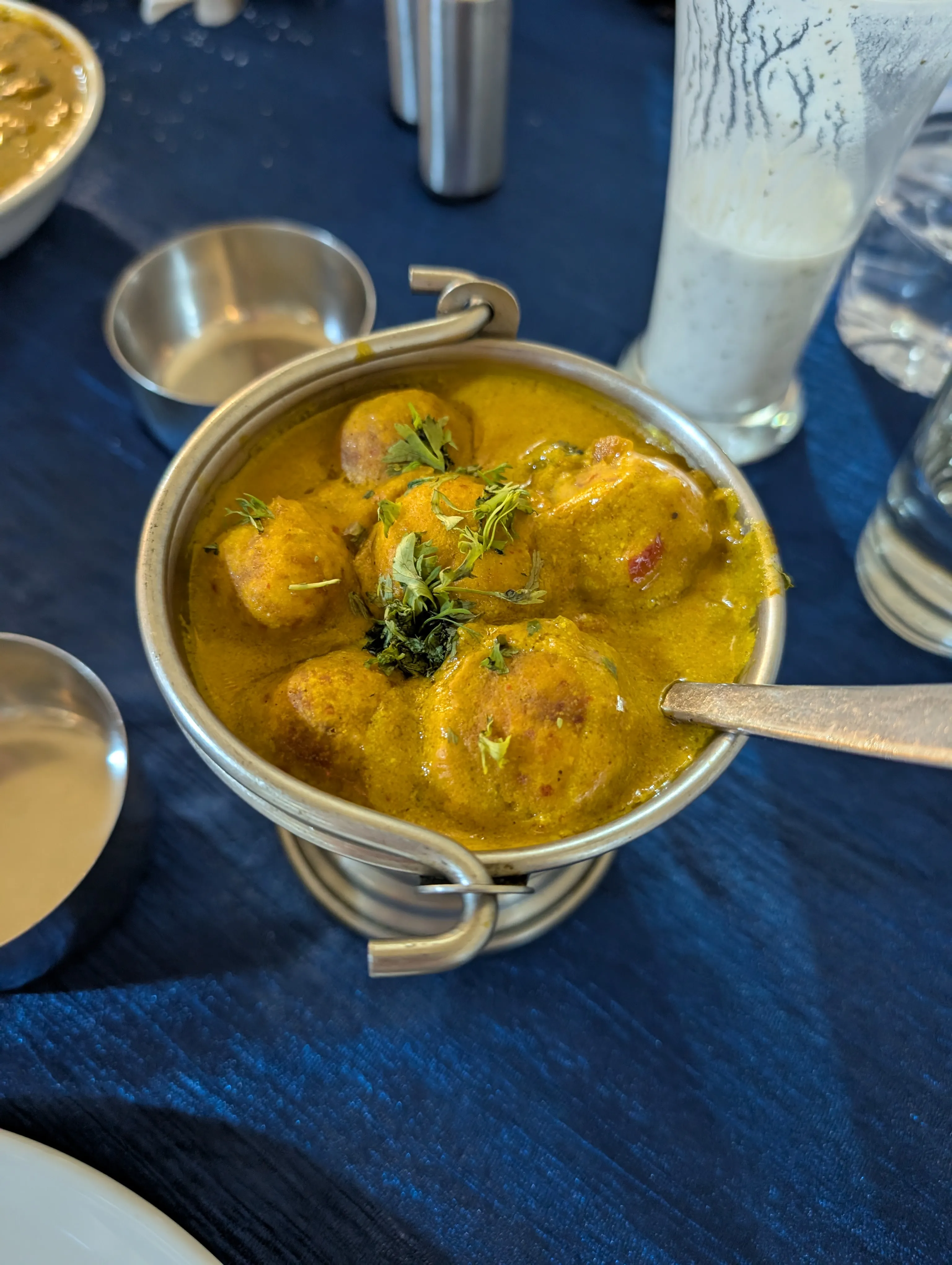
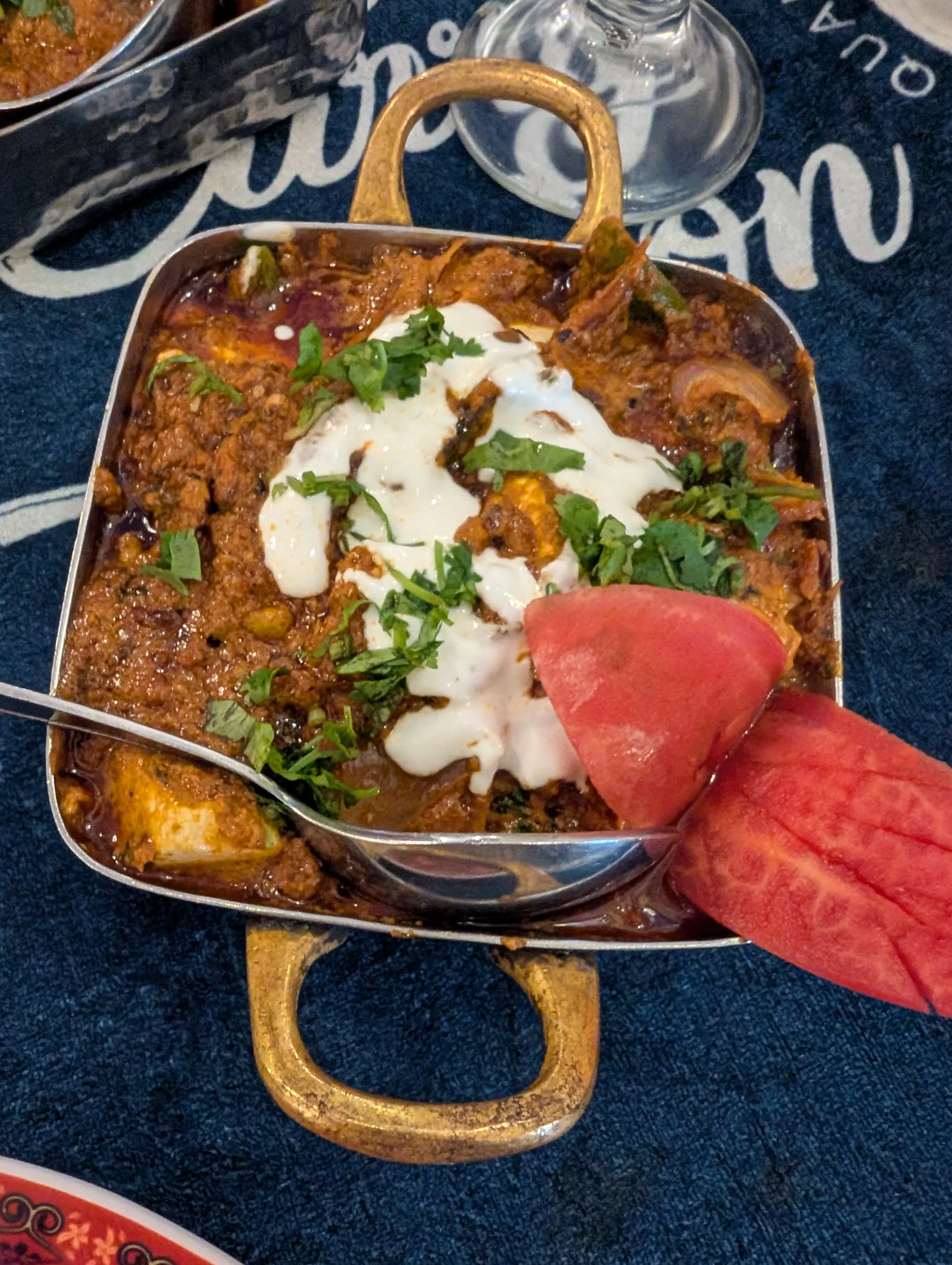
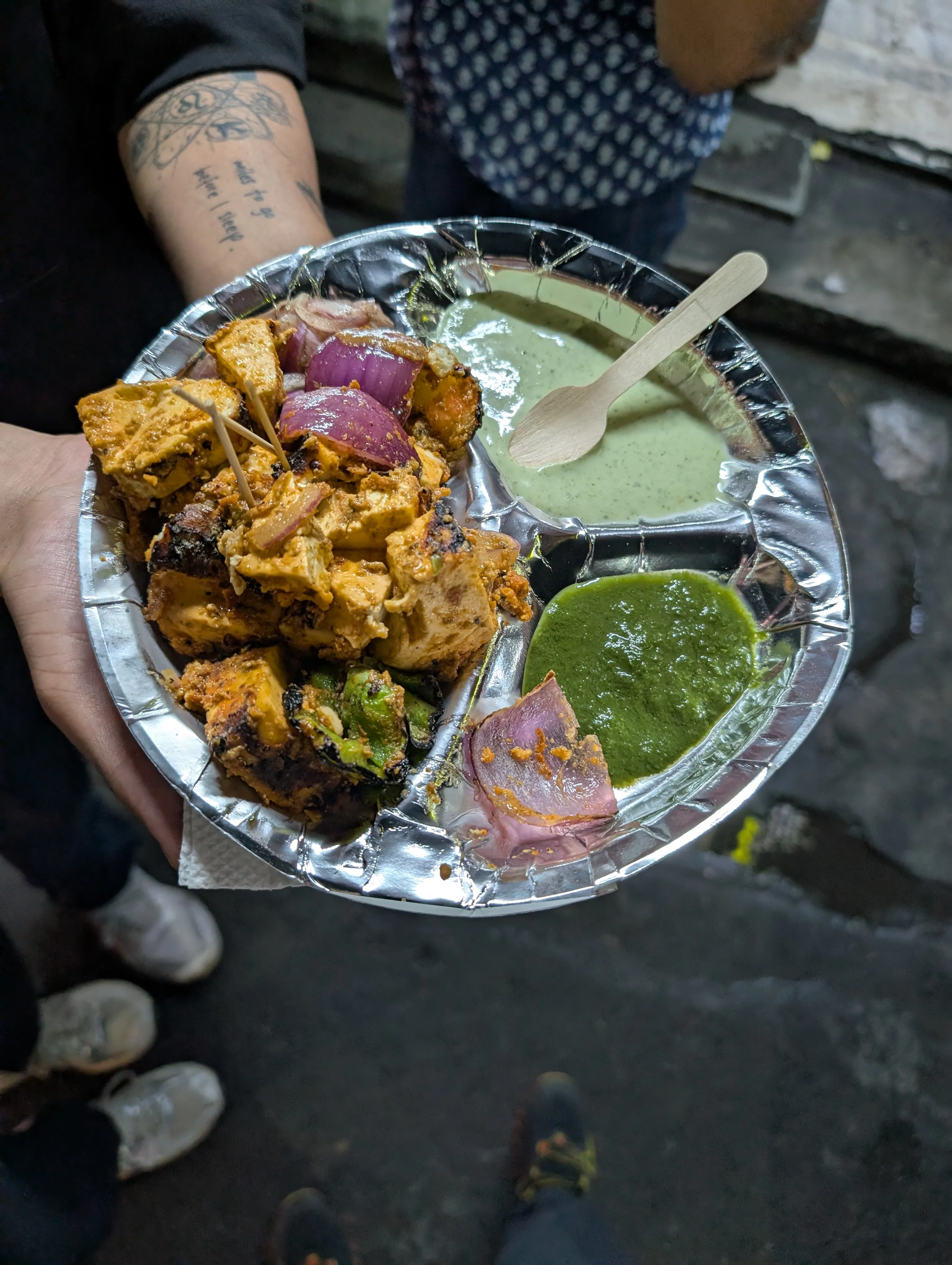
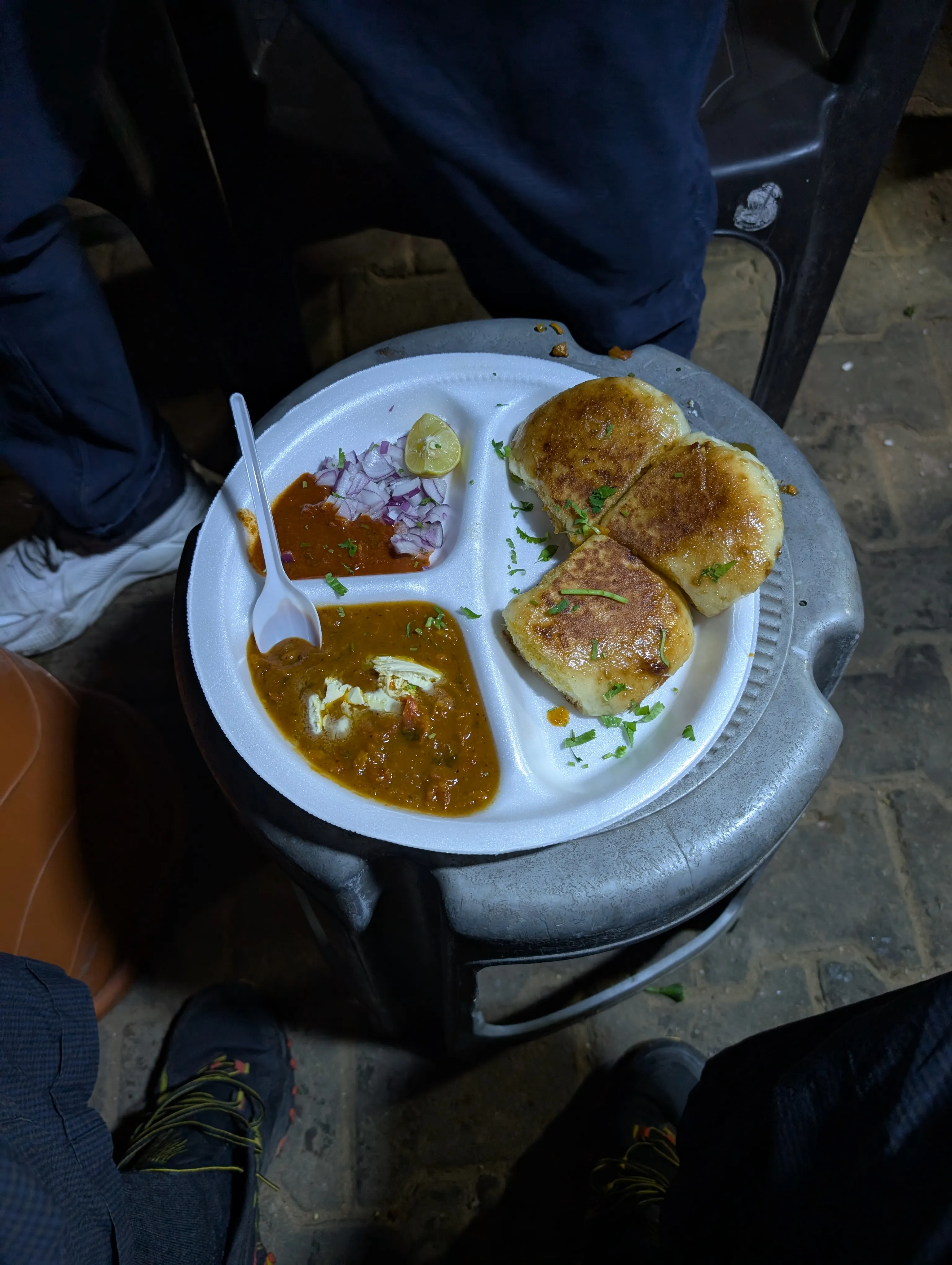
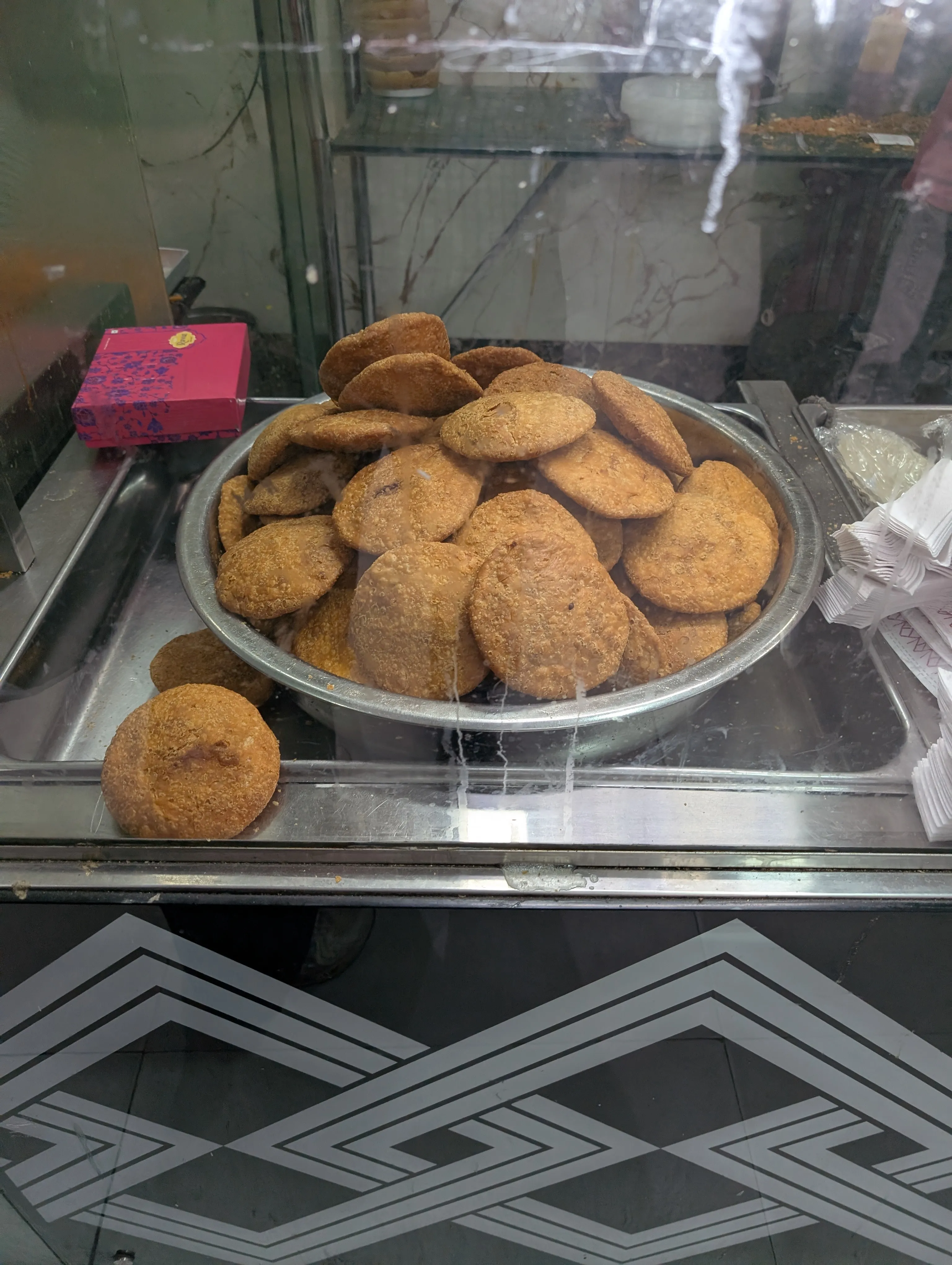
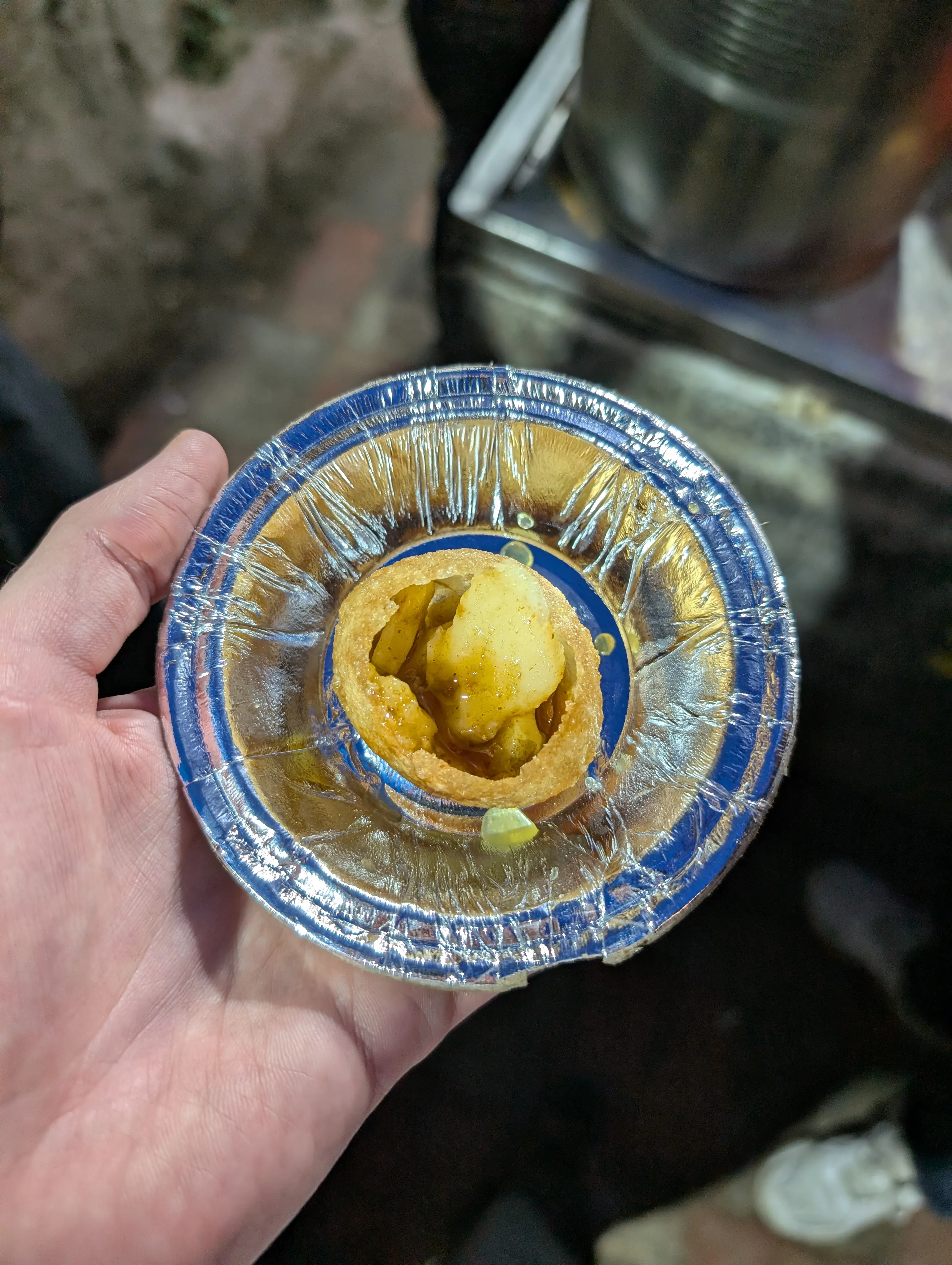
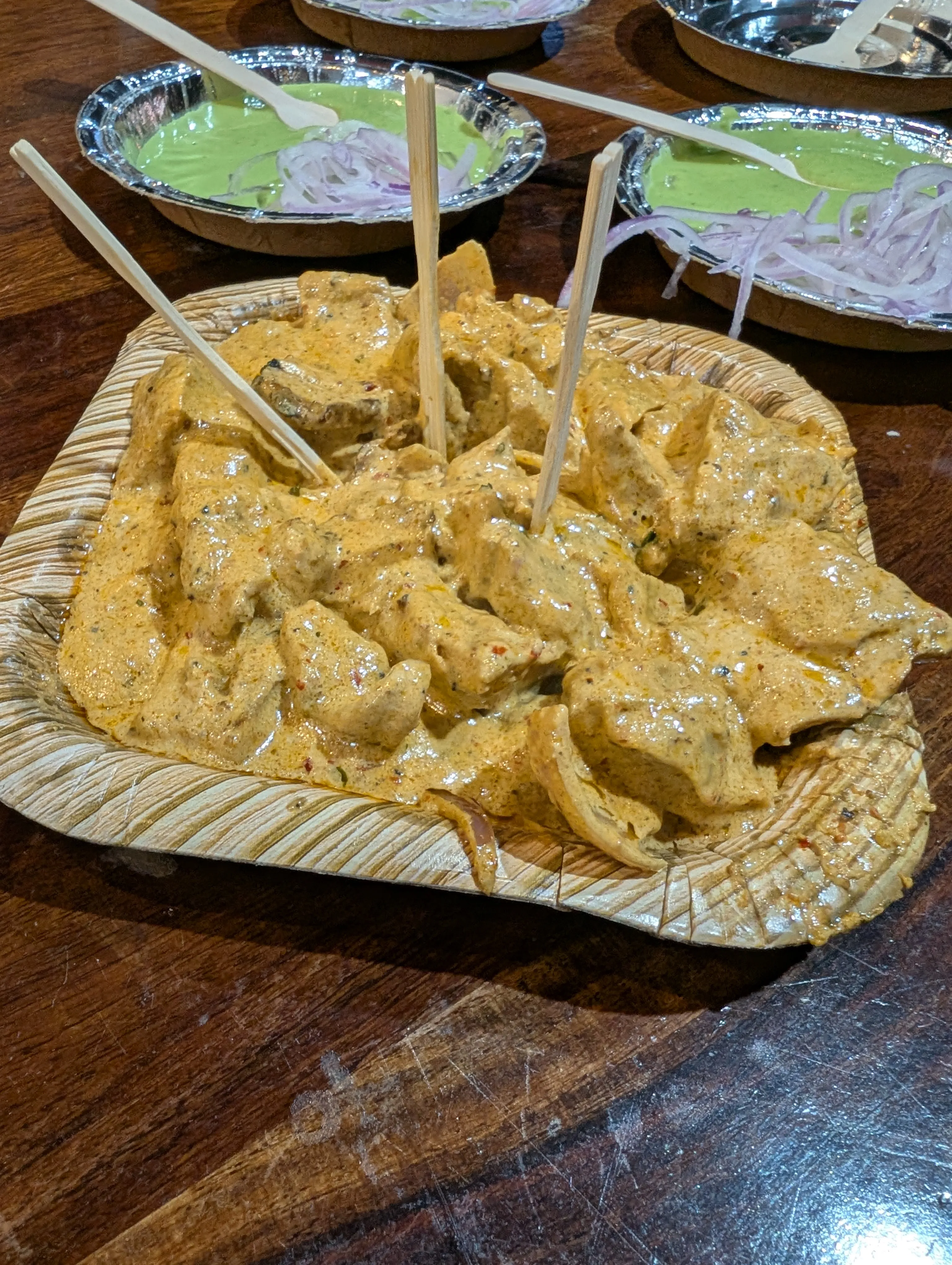
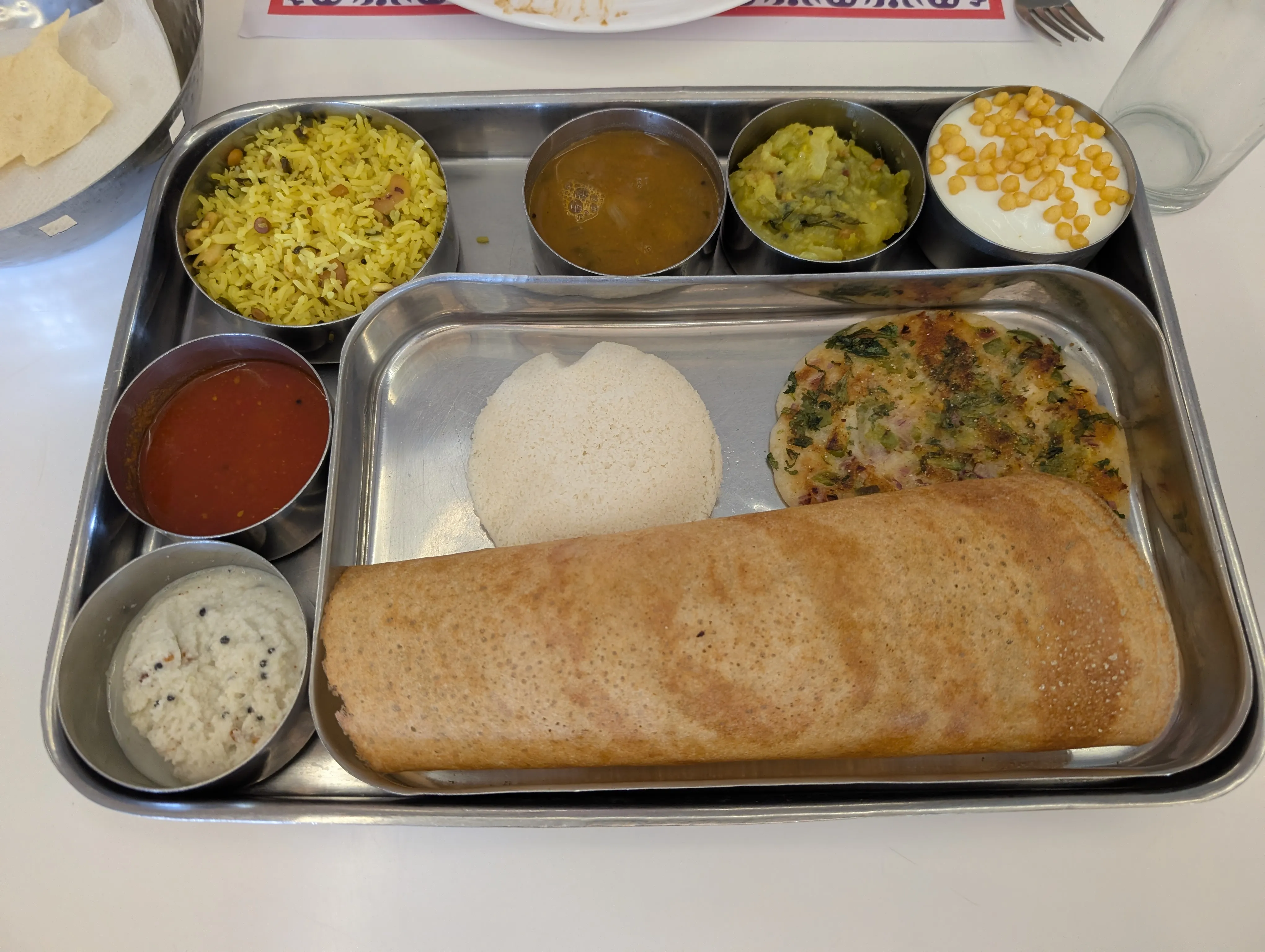
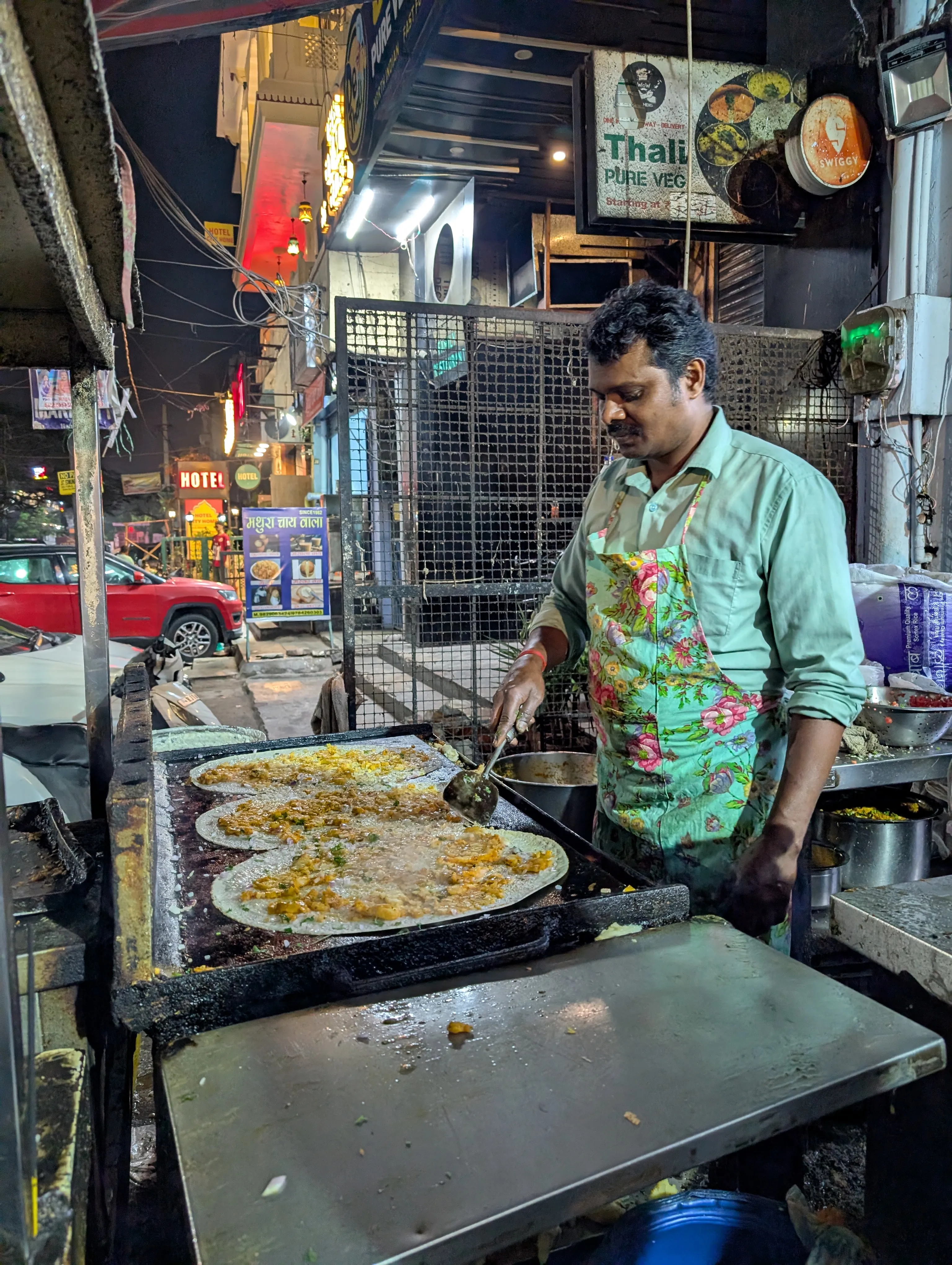
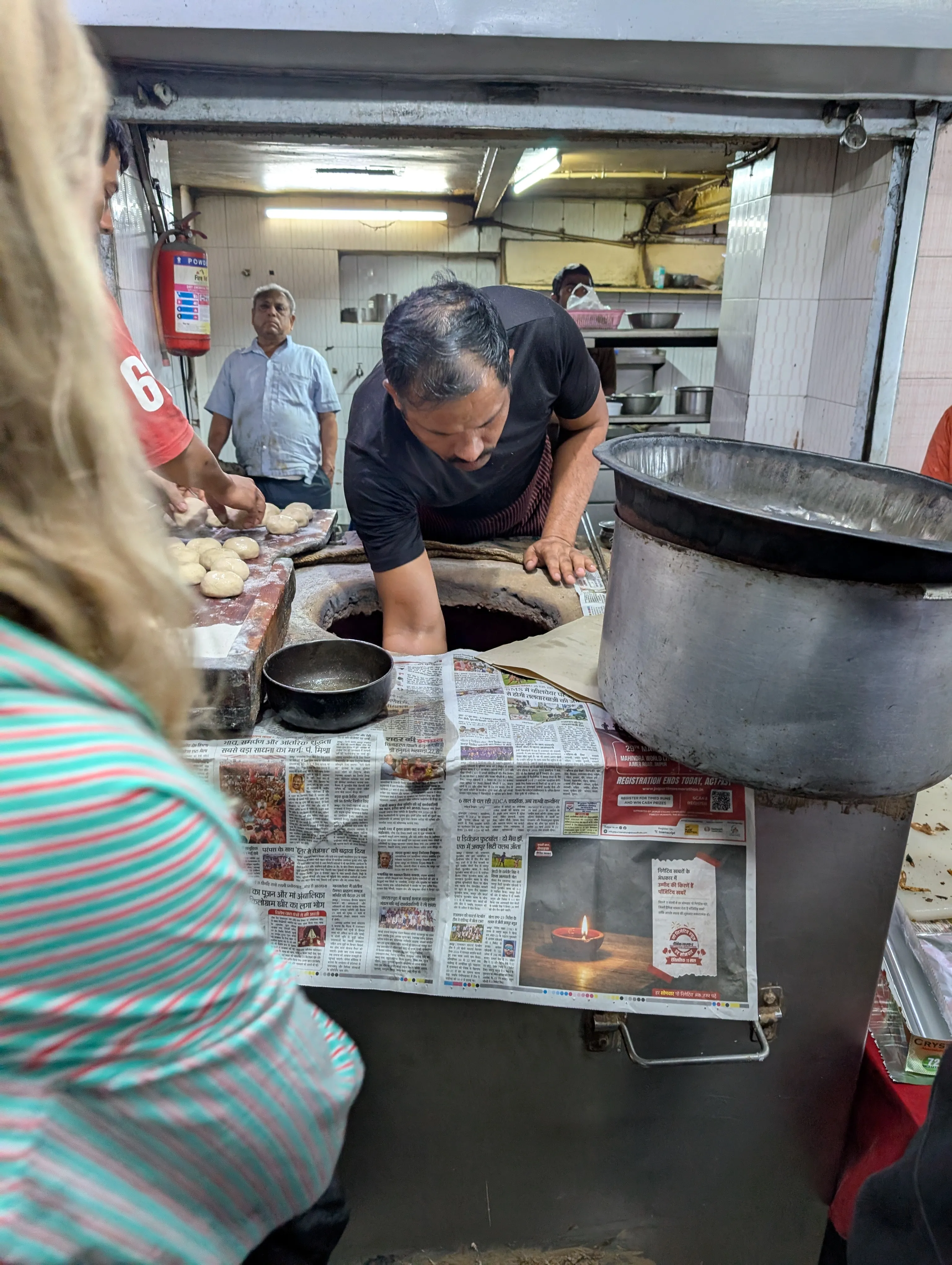
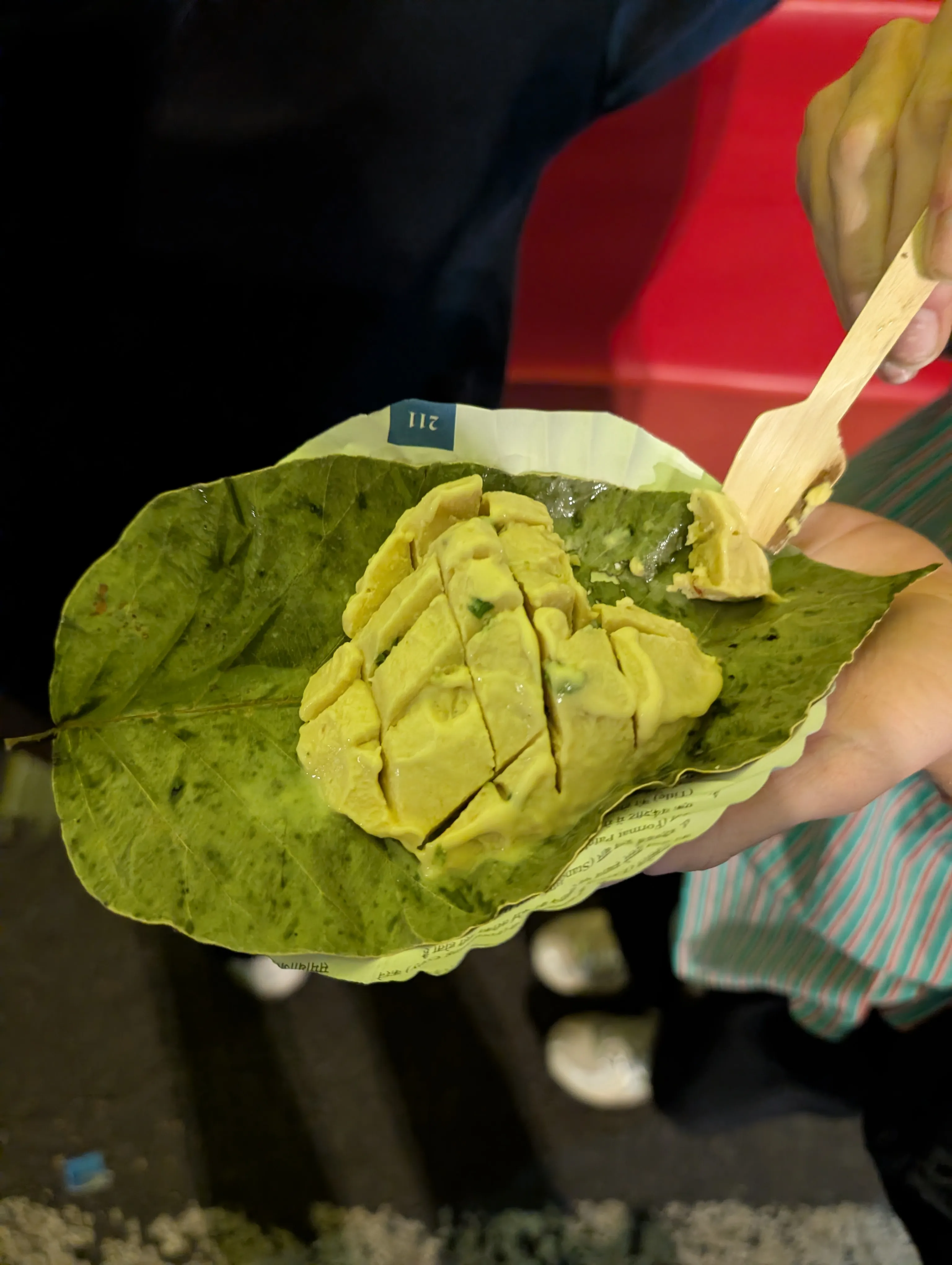
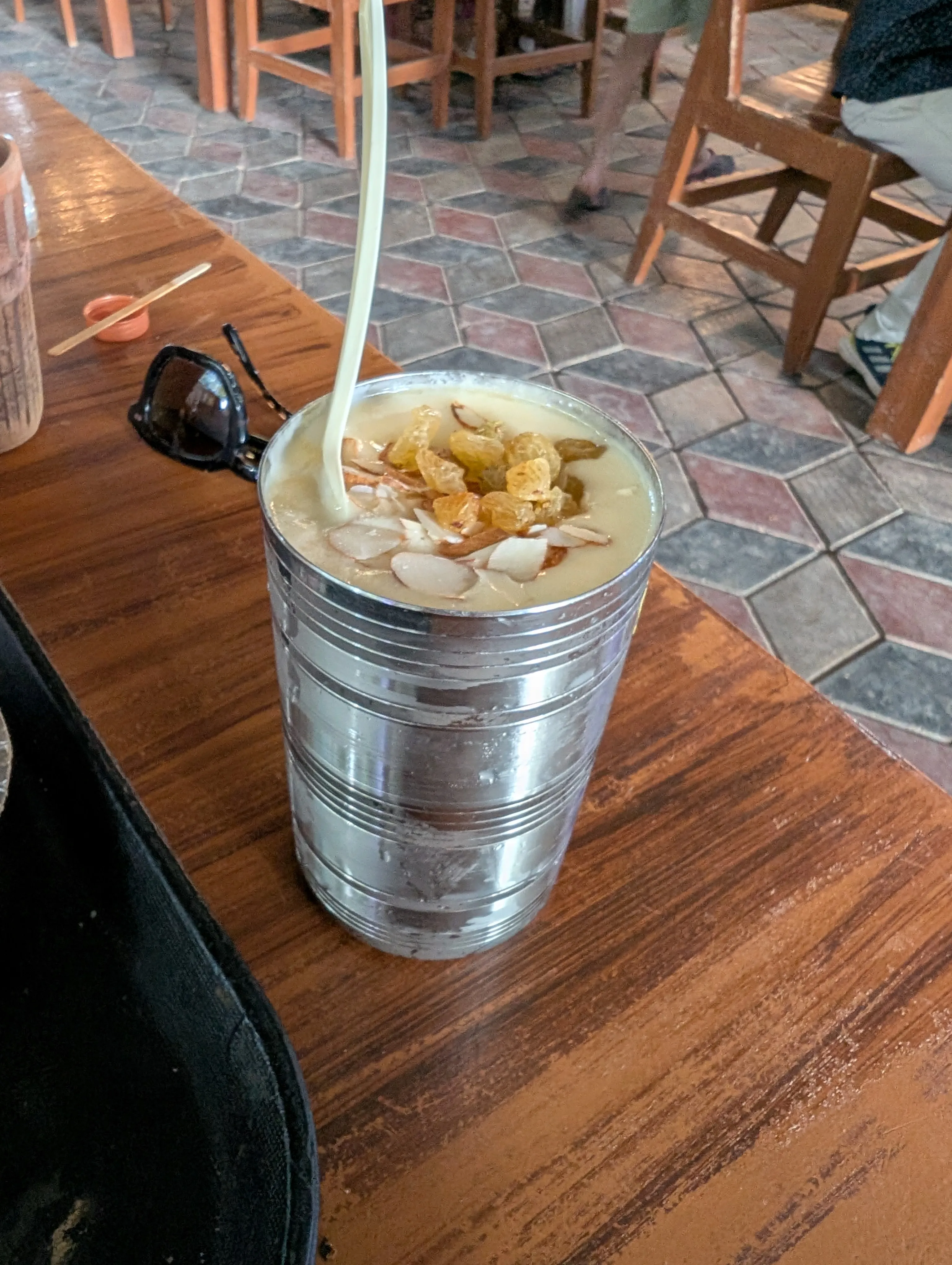
Makeda with the thali at Mohan restaurant in Jaipur. The lachha paratha was the best of the trip.
2. Platonic touching (Paul)
There is a wonderful norm in India for close male friends to hold hands or put their arms around each other while out and about. It is a platonic gesture of trust and companionship that contrasts with my Western socialization, where most male physical contact does not extend beyond a handshake or a quick bro-hug. Even in the liberal bubble of Sonoma County, I grew up hearing “no homo” hastily appended to any phrase or contact that might toe the line of otherwise strict heterosexual guardrails. Anecdotally, this thankfully seems to be changing among Gen Z men with the rise of “kissing the homies” and other forms of semi-platonic contact. So in India it always made us smile to see men of all ages holding hands and expressing this simple form of affection. Guys: get ready to hold hands when I’m back in the States.
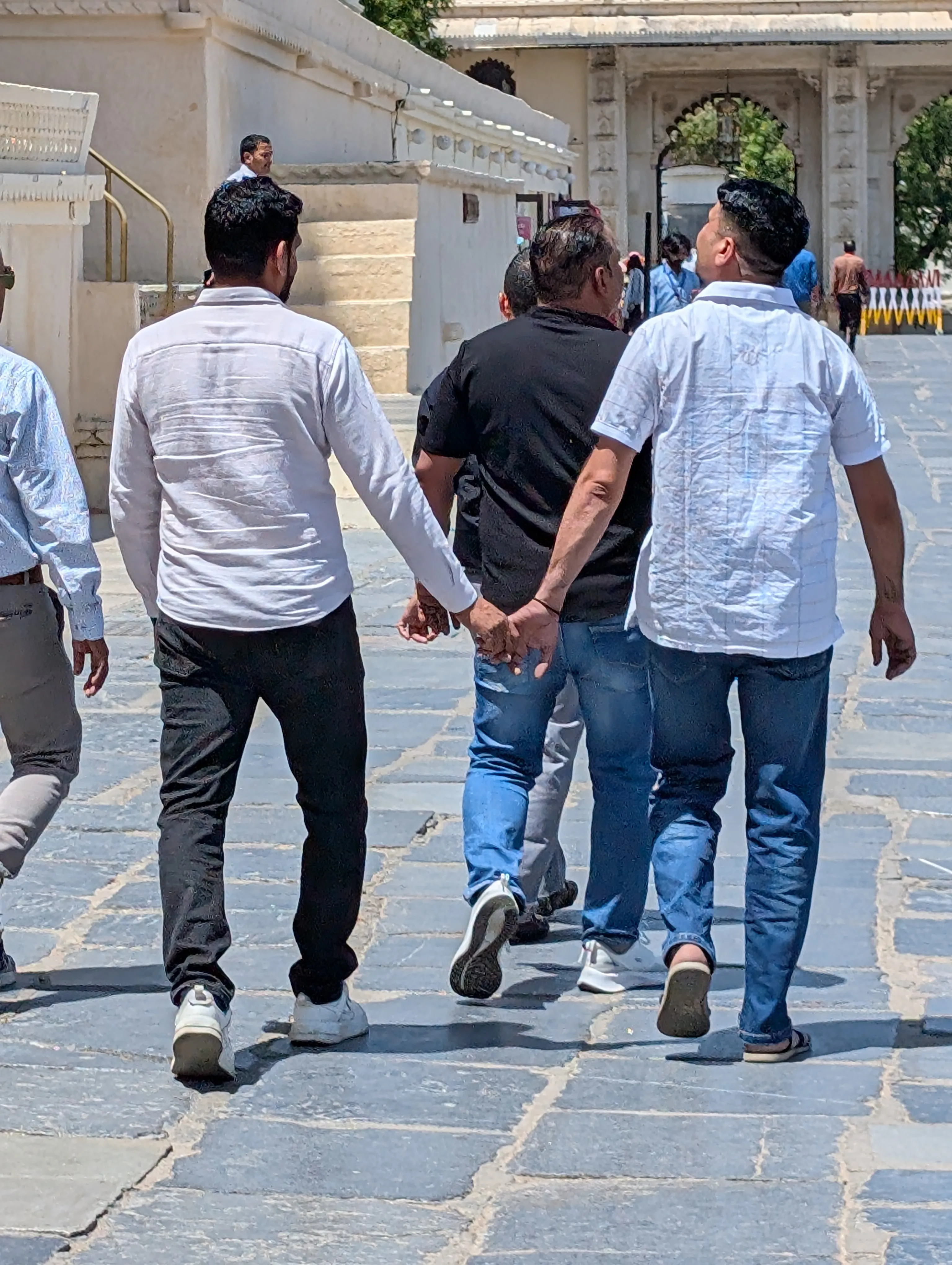 Two men holding hands.
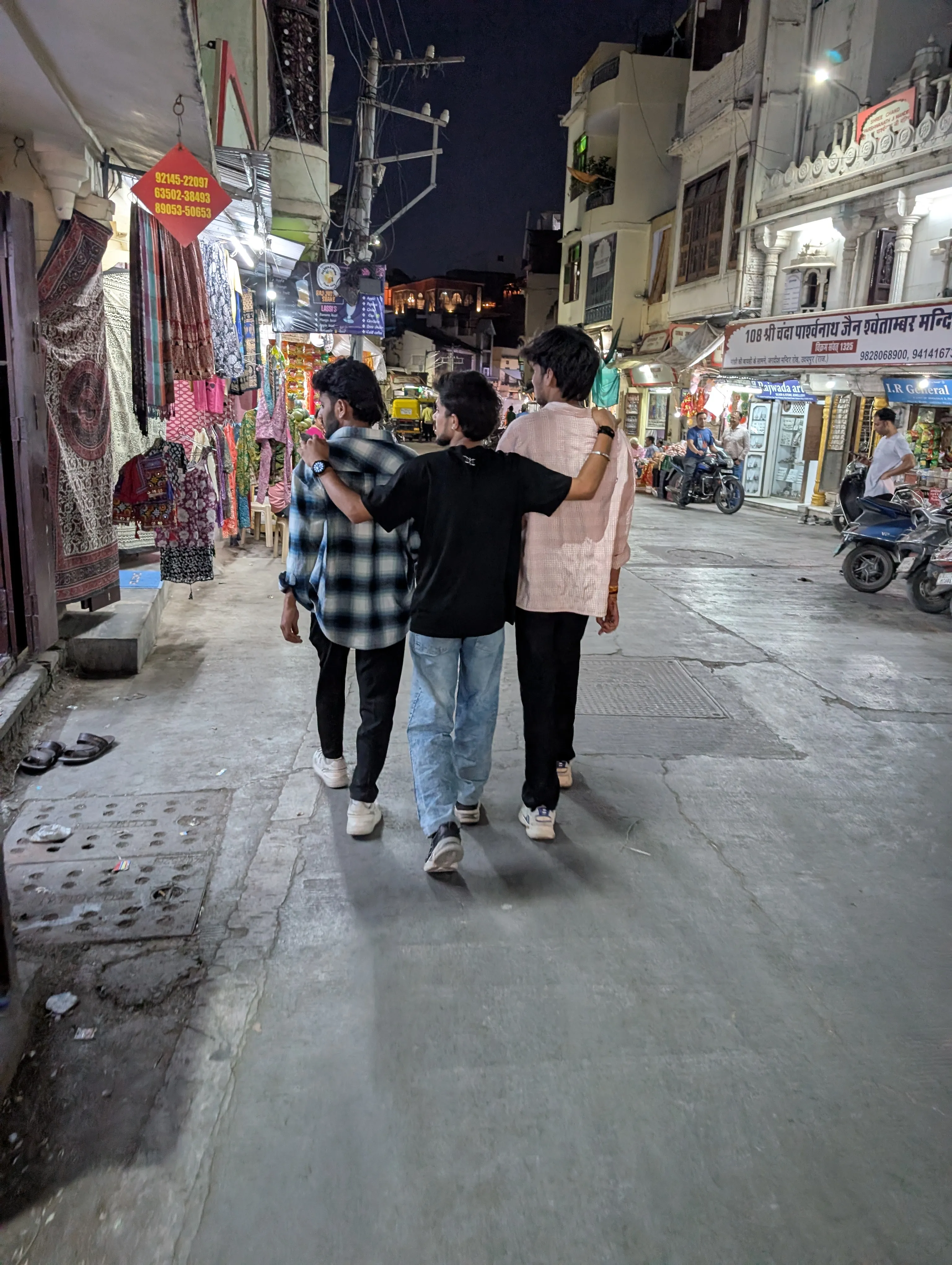 Friends out and about.
3. Colors (Paul)
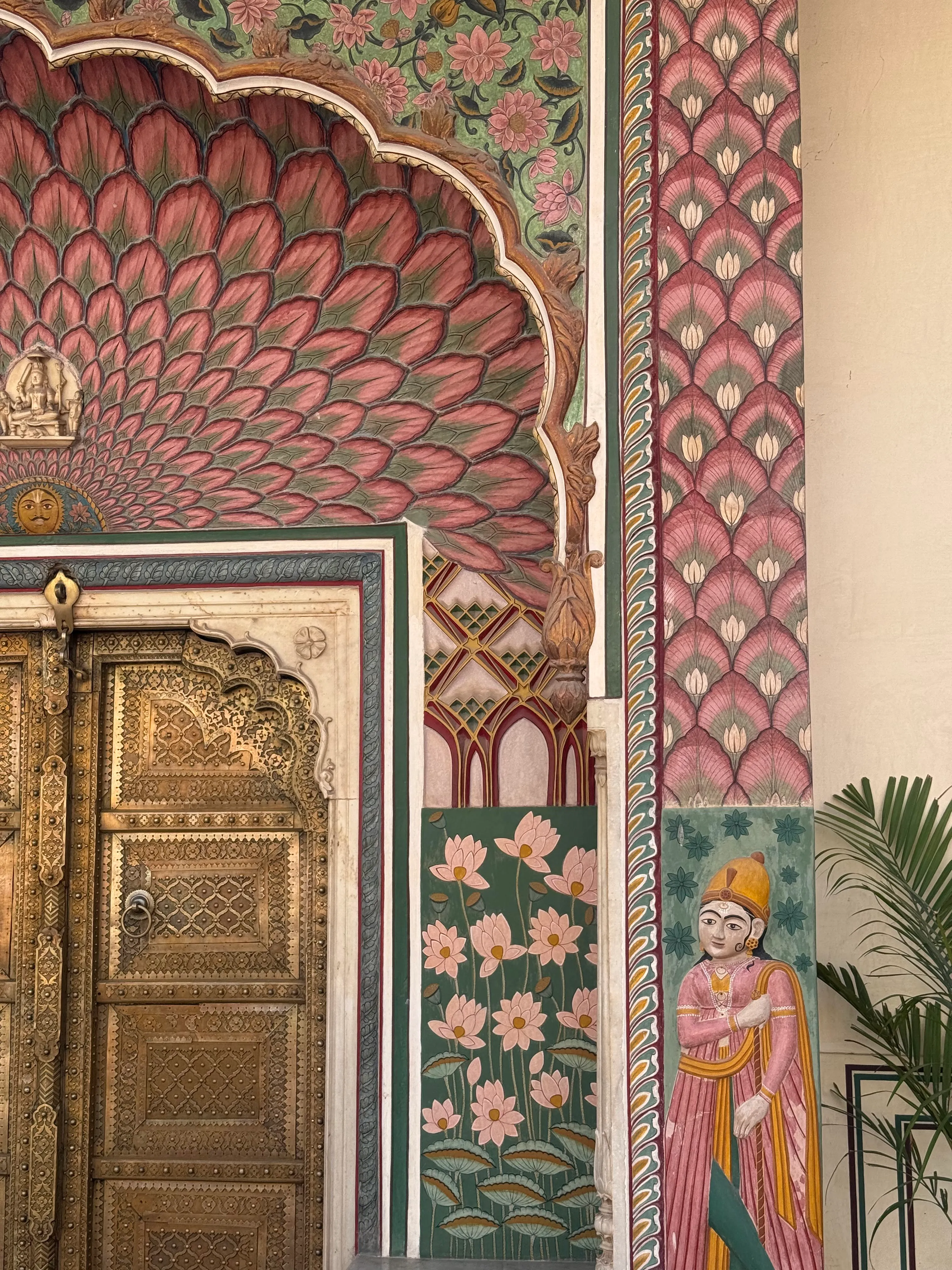
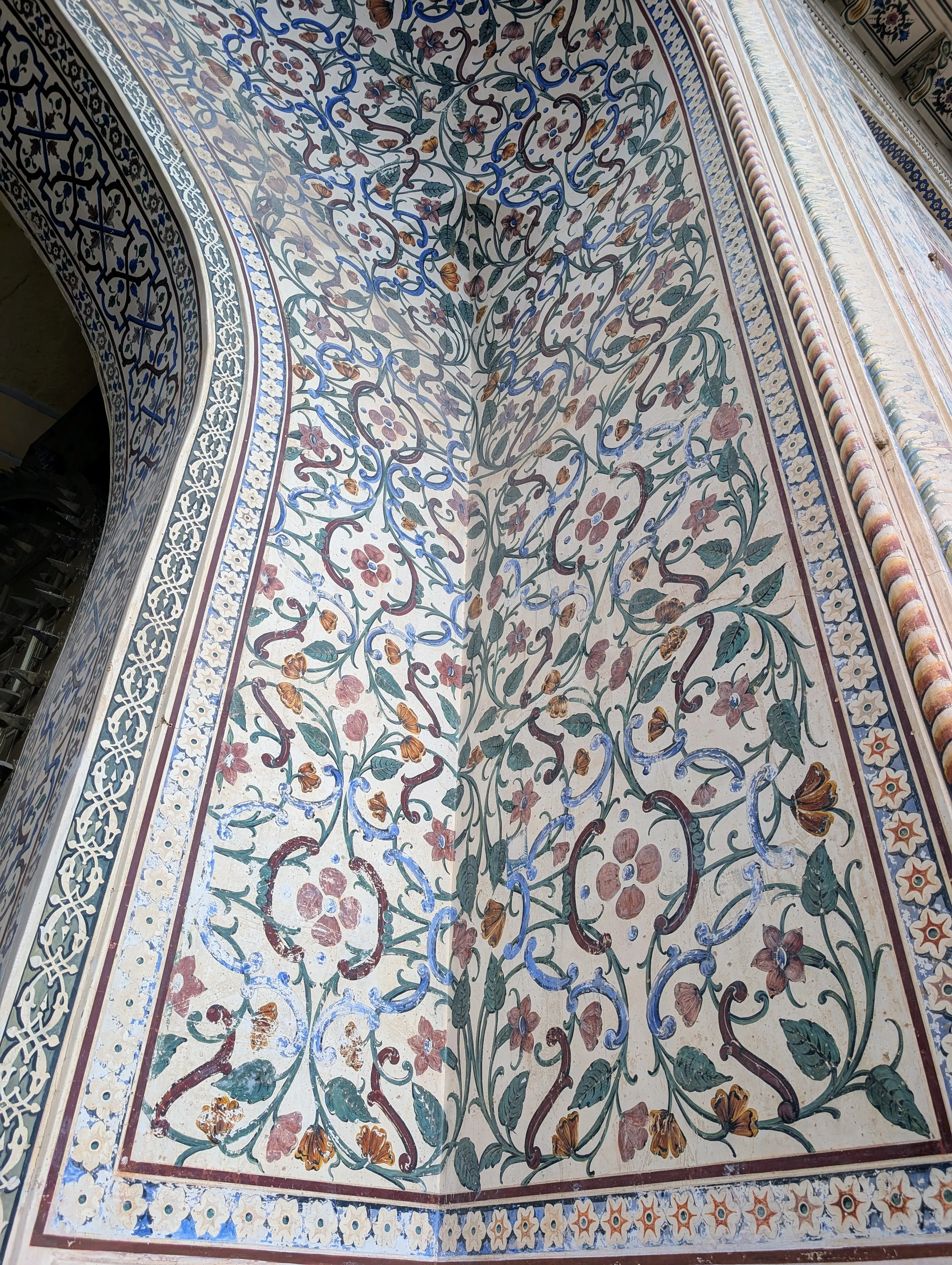
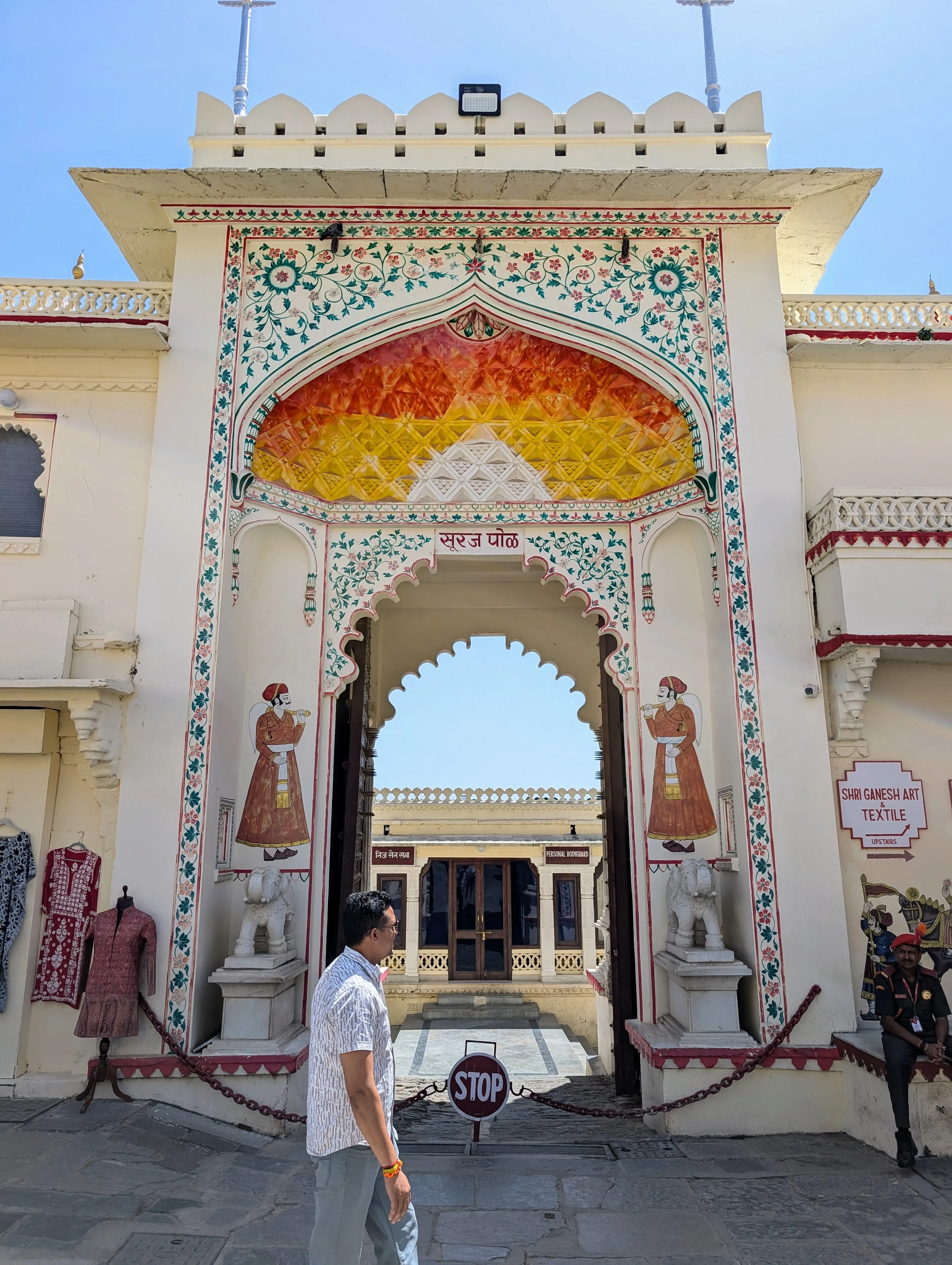
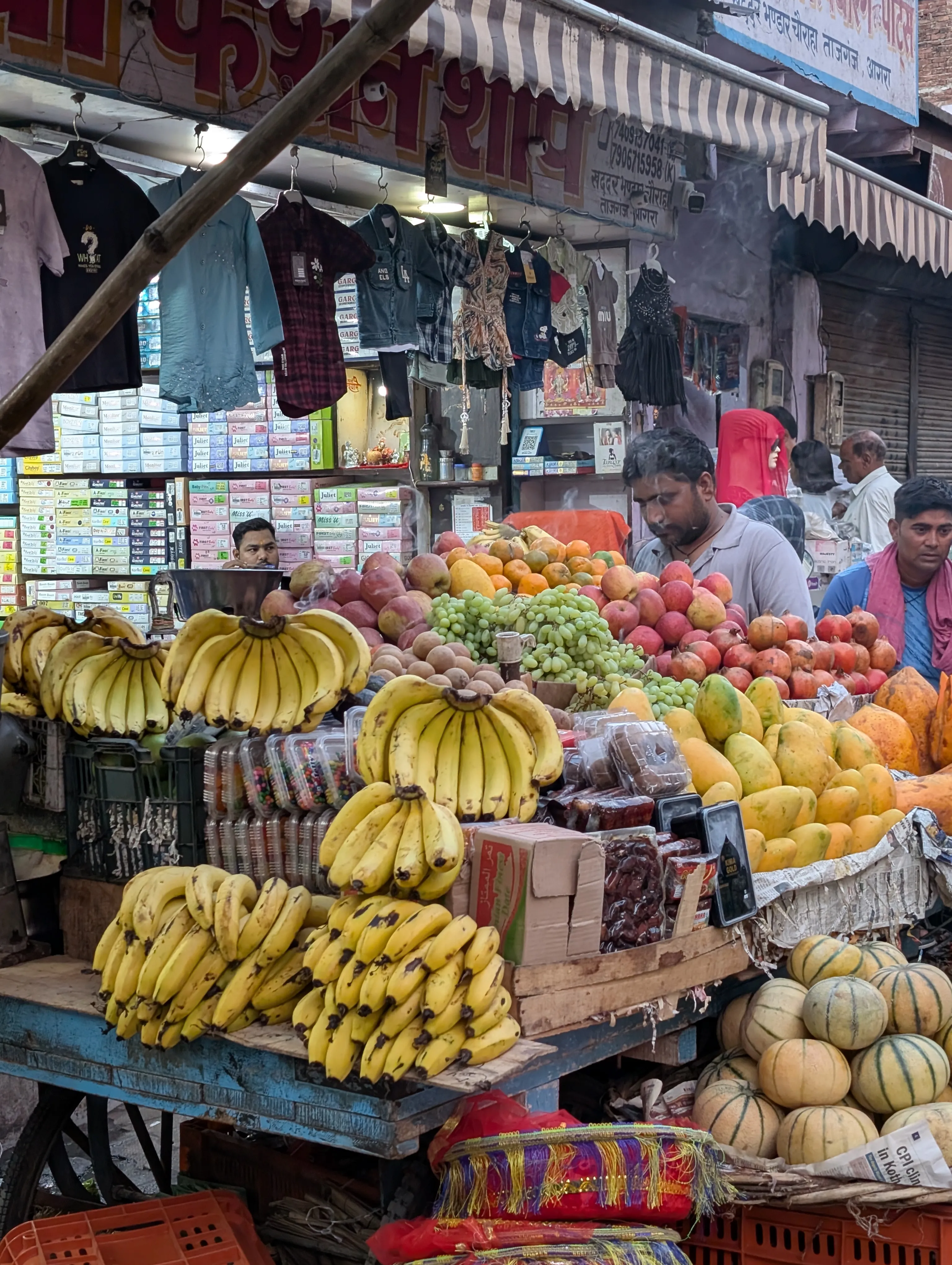
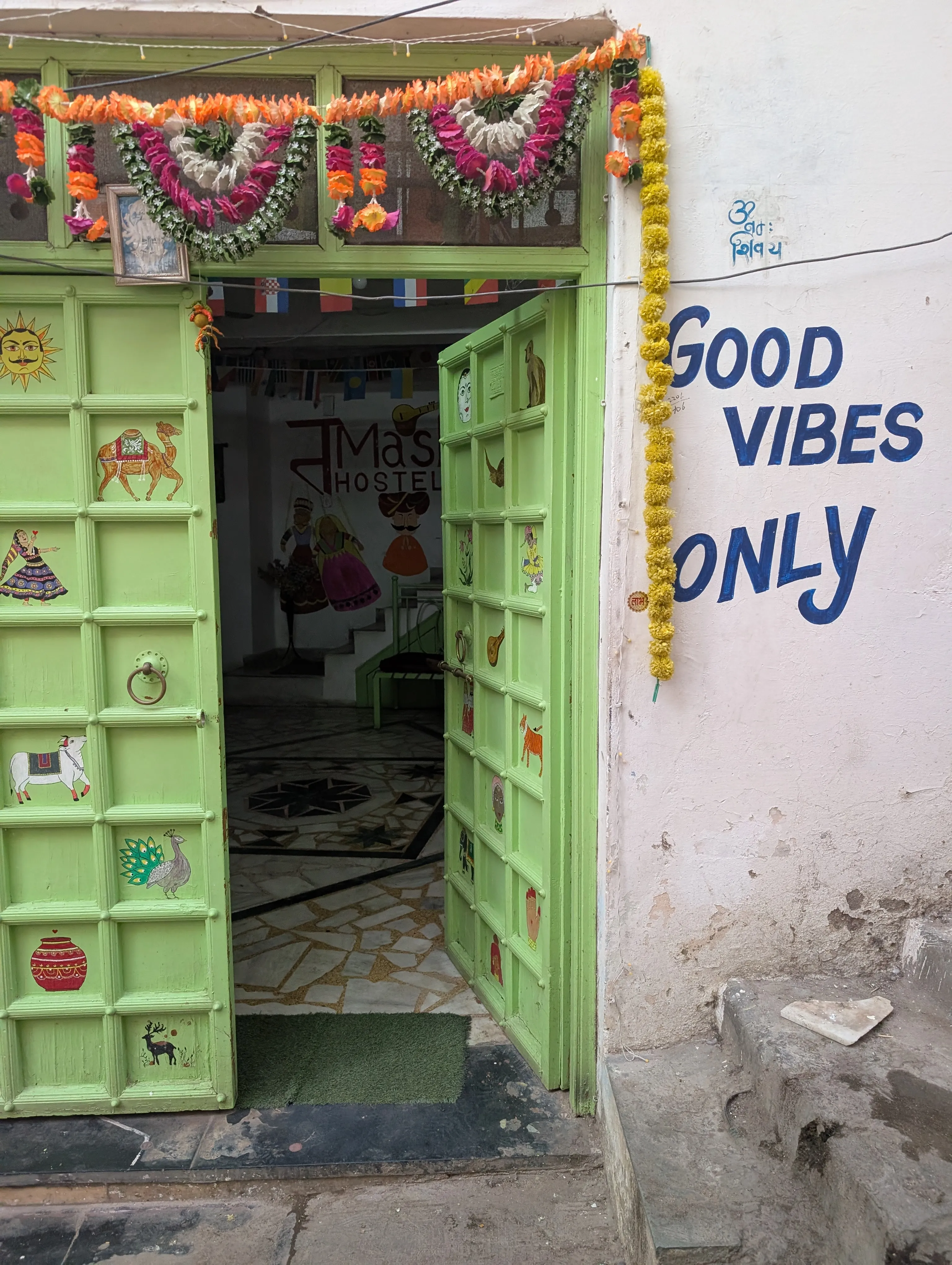
India is awash with color. Entire cities are nicknamed for their hues: Jaipur is the Pink City, Jodhpur the Blue City, Jaisalmer the Gold City. Trucks are hand-painted with ornate decorations and advertisements. Buildings are adorned with gem inlays in floral patterns. The traffic dividers have block-print stamps on them. Deep yellow marigolds are found hanging around cow necks, in wreaths, and in piles for sale on street corners. Markets overflow with bright fruits, deep green vegetables, earthy spices, and red meats.
My favorite, though, were the saris, kurtas, and cholis. Women everywhere are draped in the most beautiful fabrics imaginable in the brightest hues: red, pink, green, yellow, orange, blue, trimmed in gold and sequins. It was dumbly revelatory for me: Indian women just go about their days as if they are not clad in celestial garments; they shop, hawk wares, pray, meet friends, anything - while adorned in fabrics that seem fit for the most sacred of ceremonies, clothes that surely must be reserved for those few times in life that exceed the rest. It truly filled me with joy every day, and thinking of my general wardrobe in contrast made me feel like a medieval peasant.
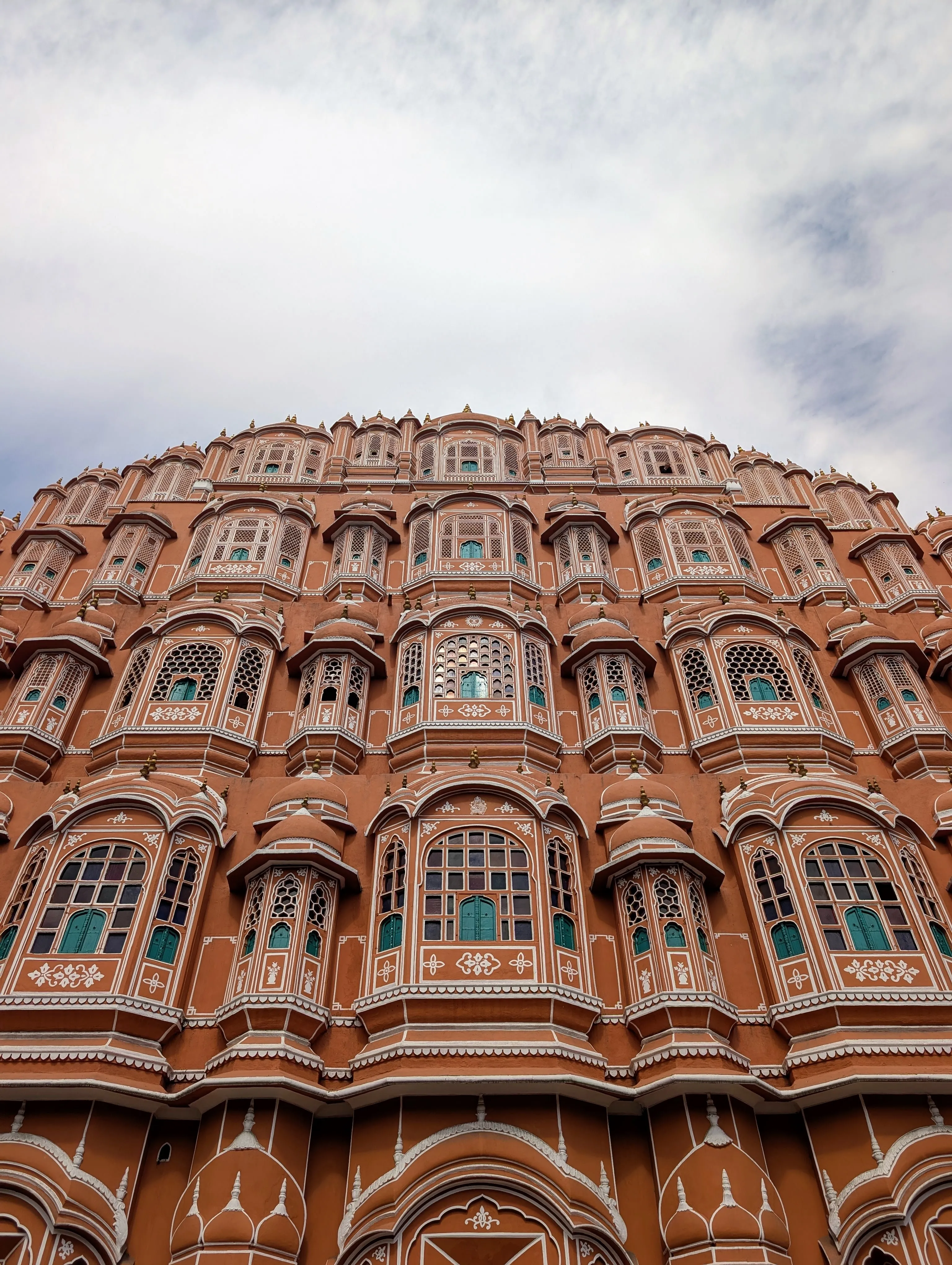
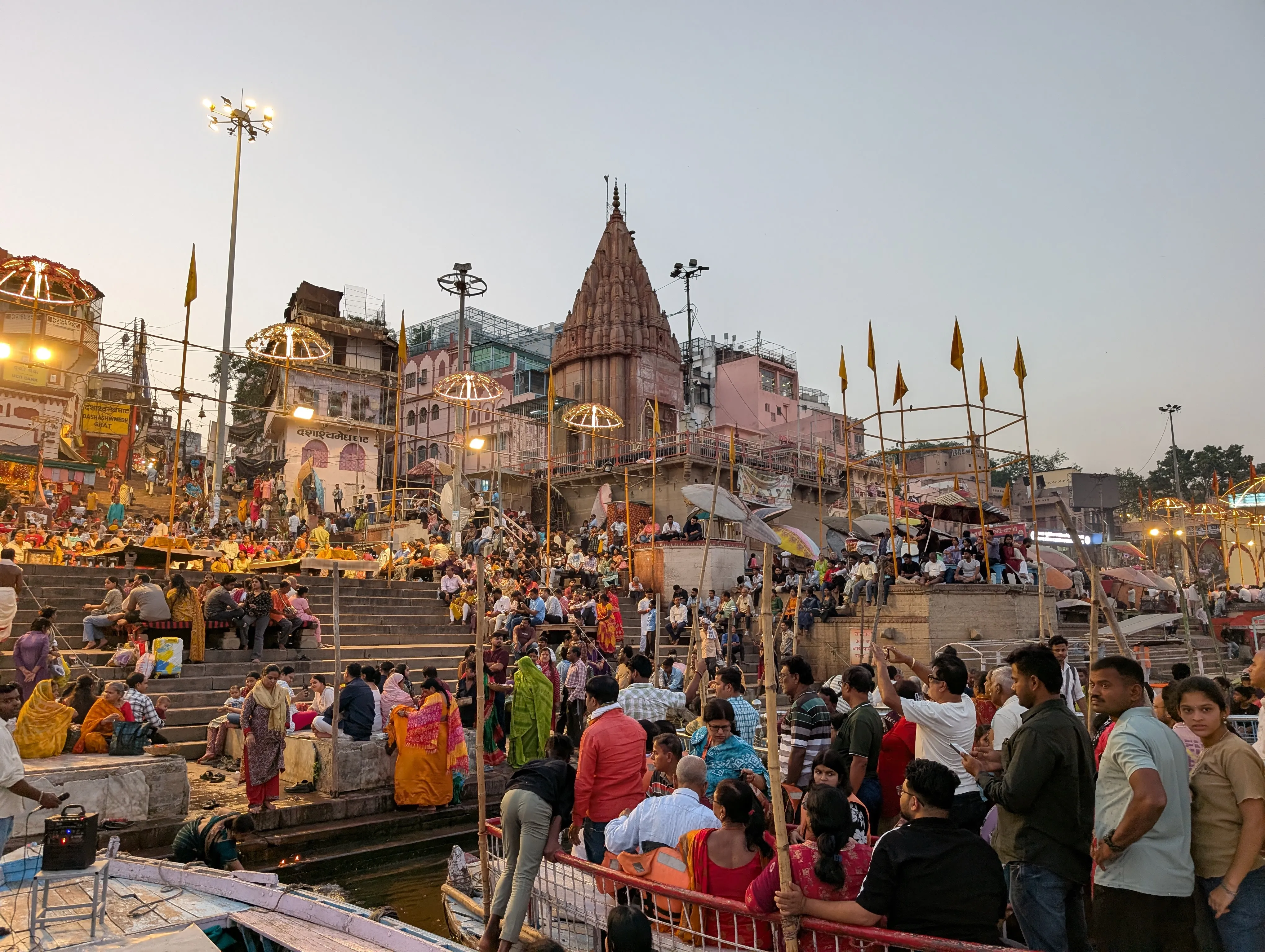
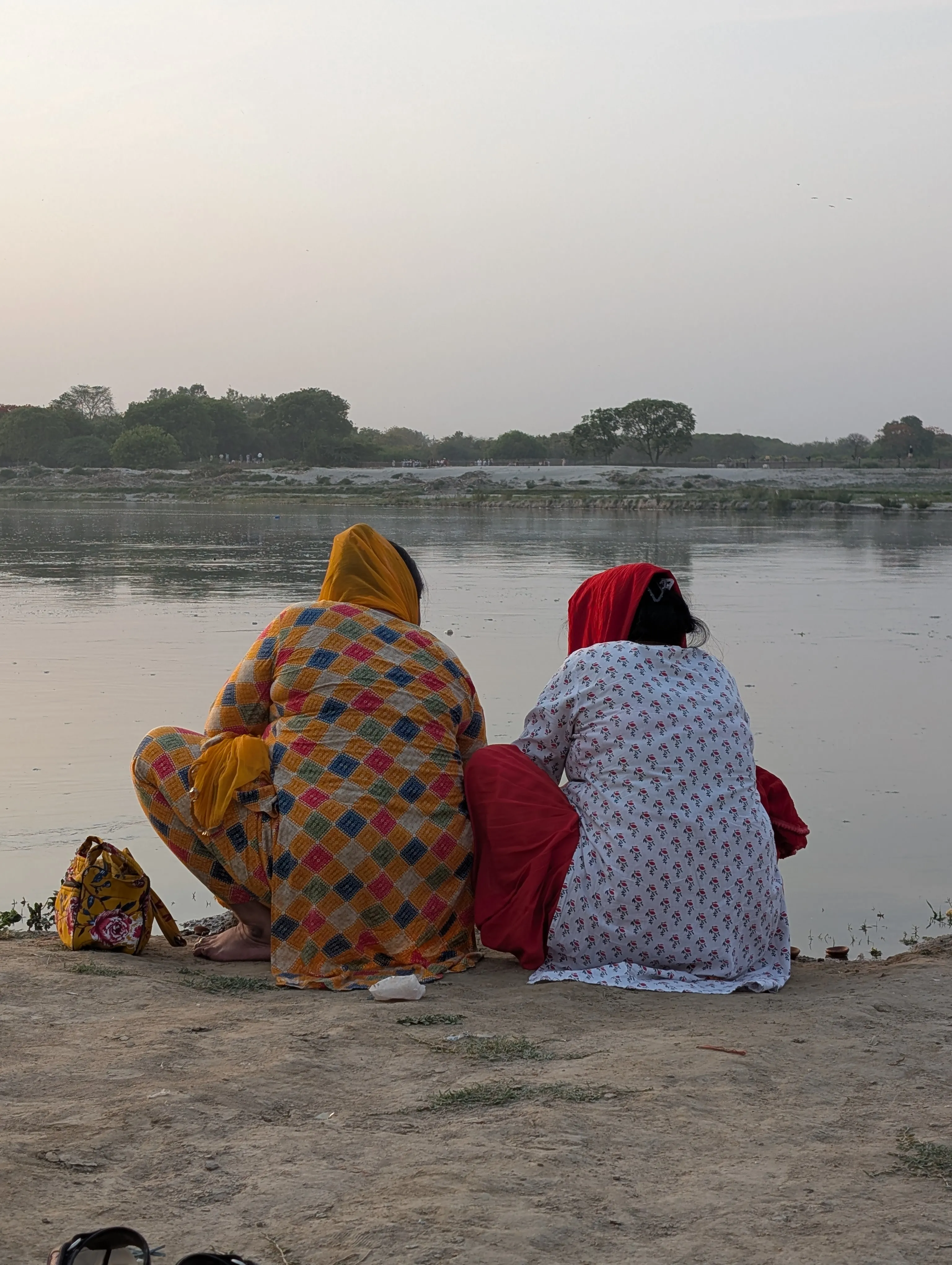
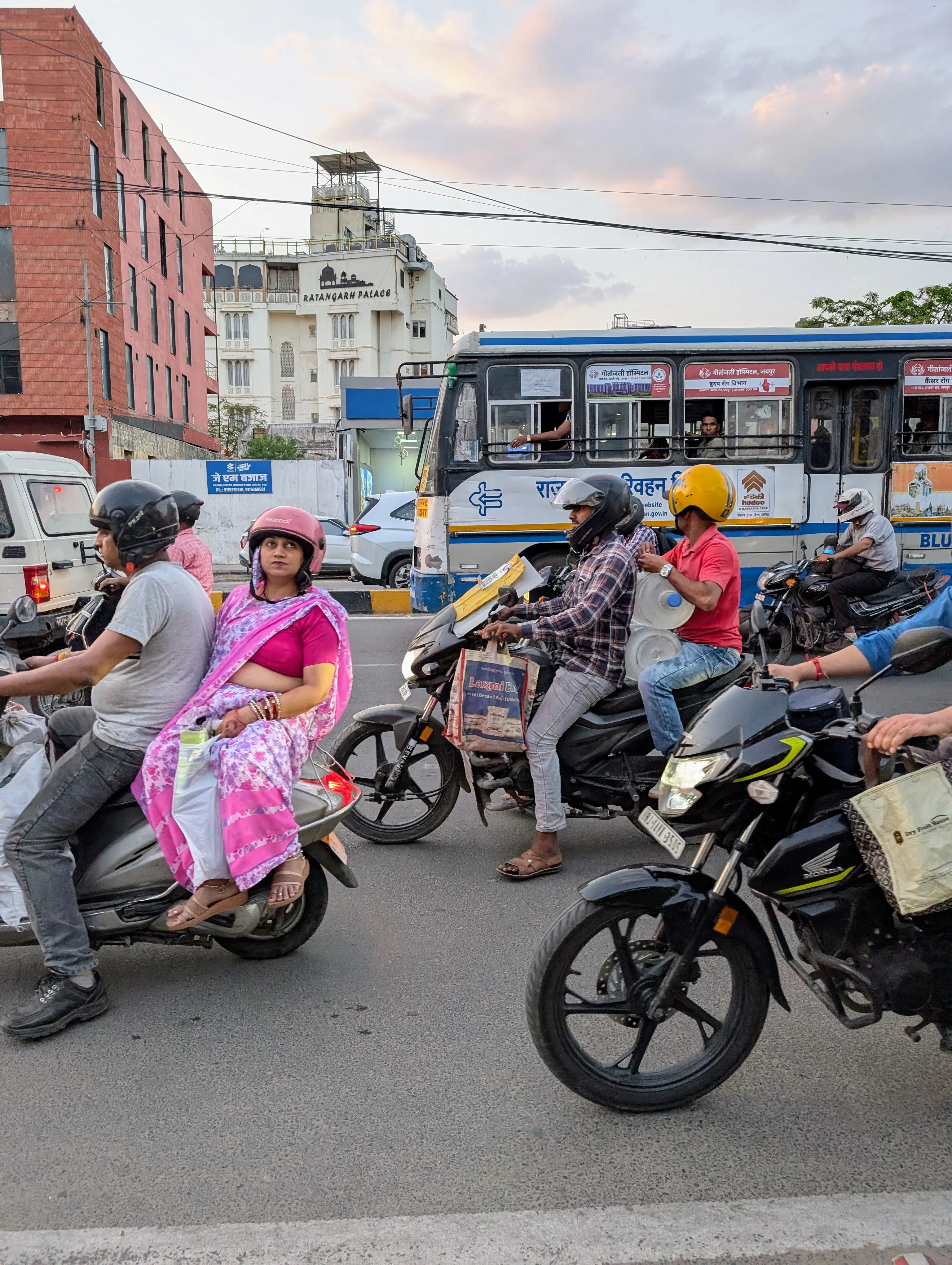
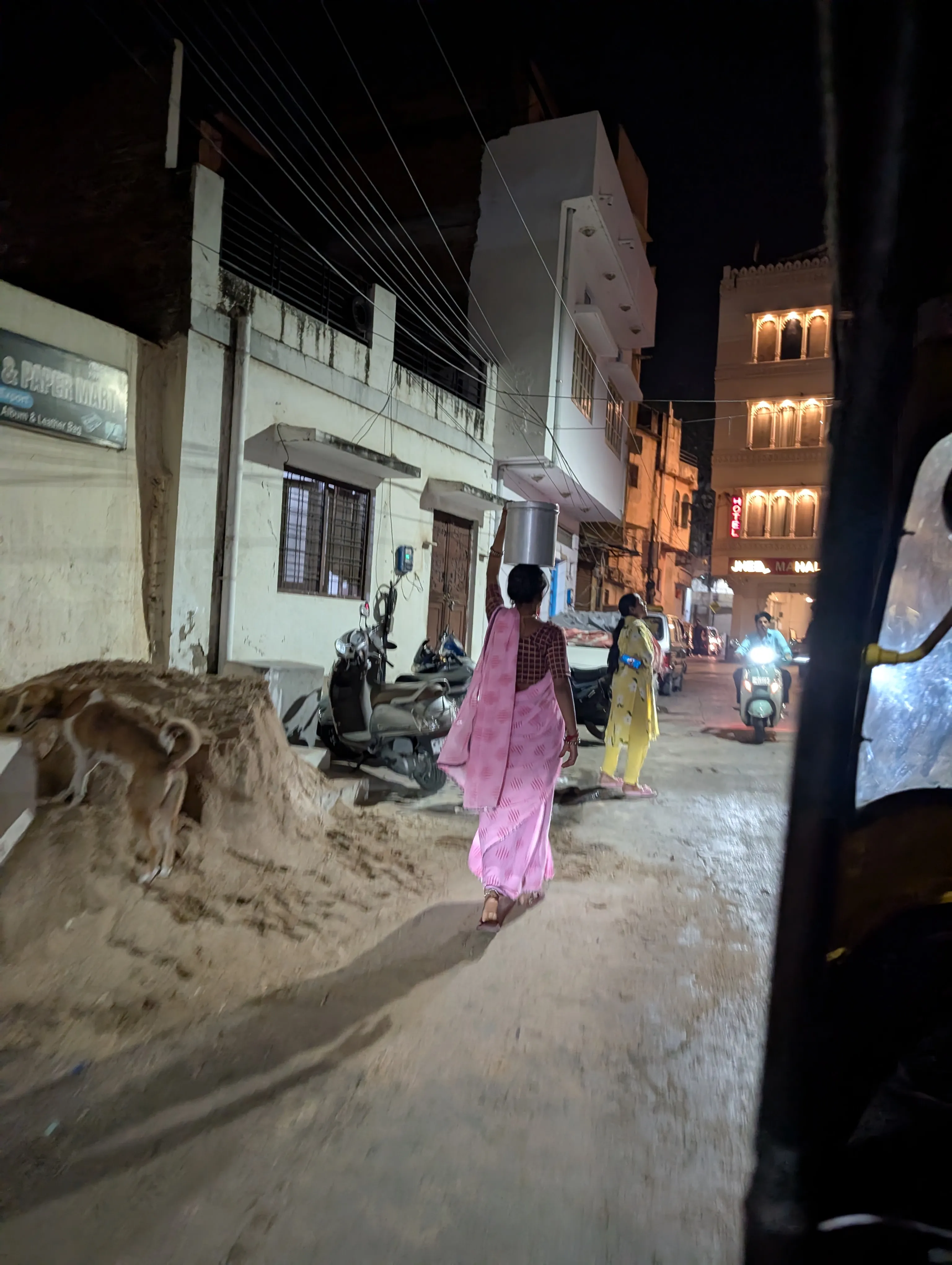
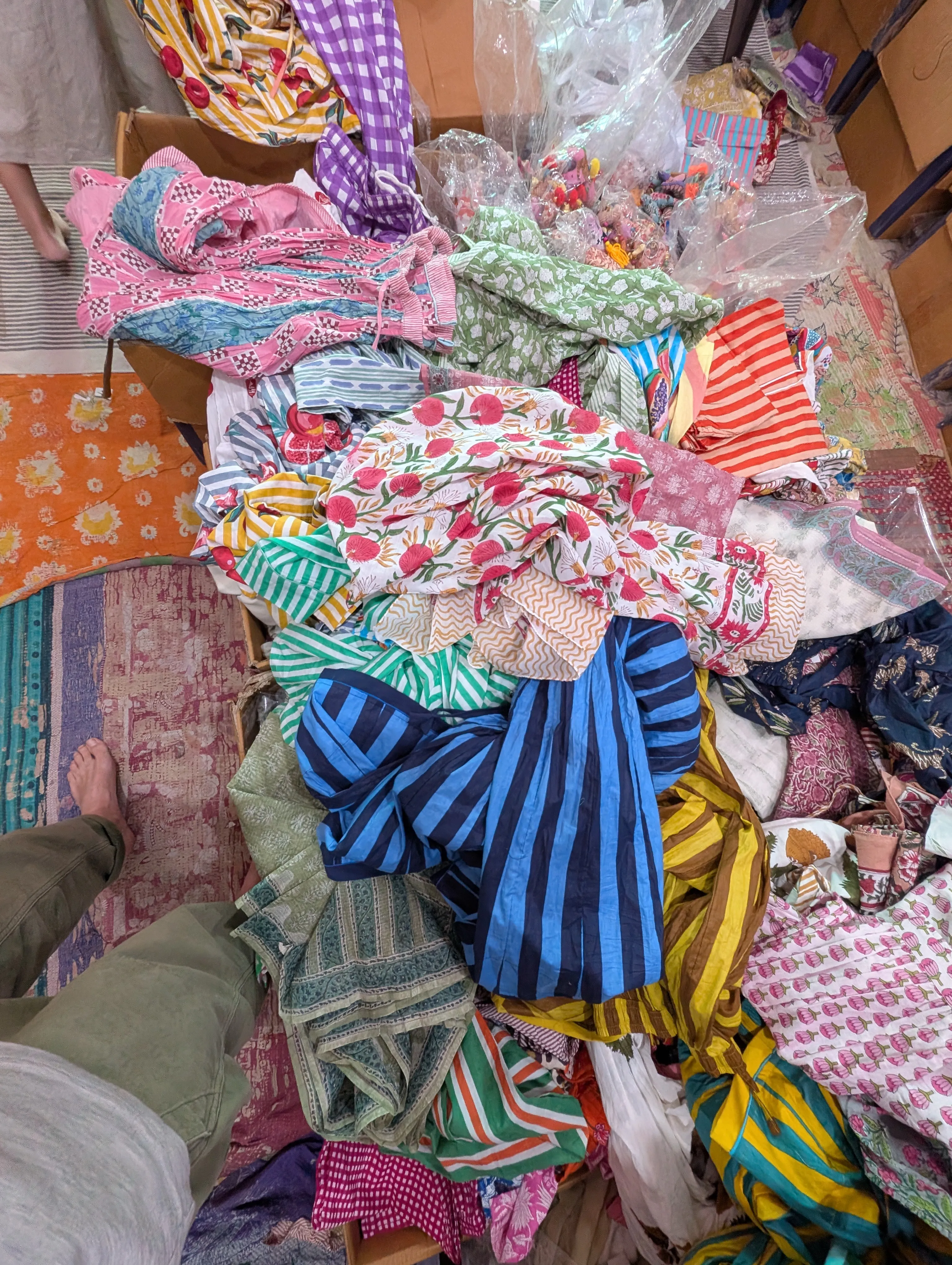
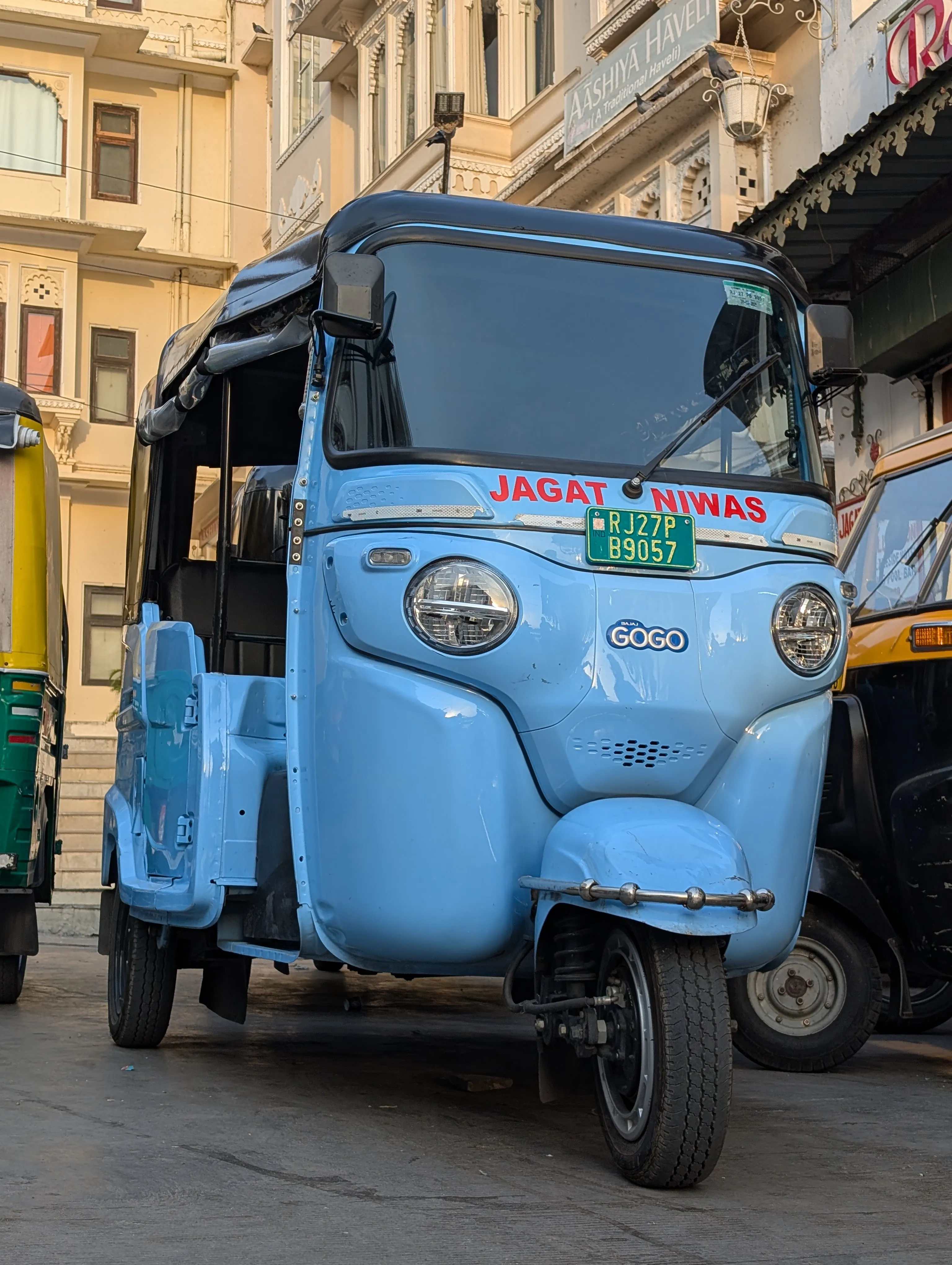
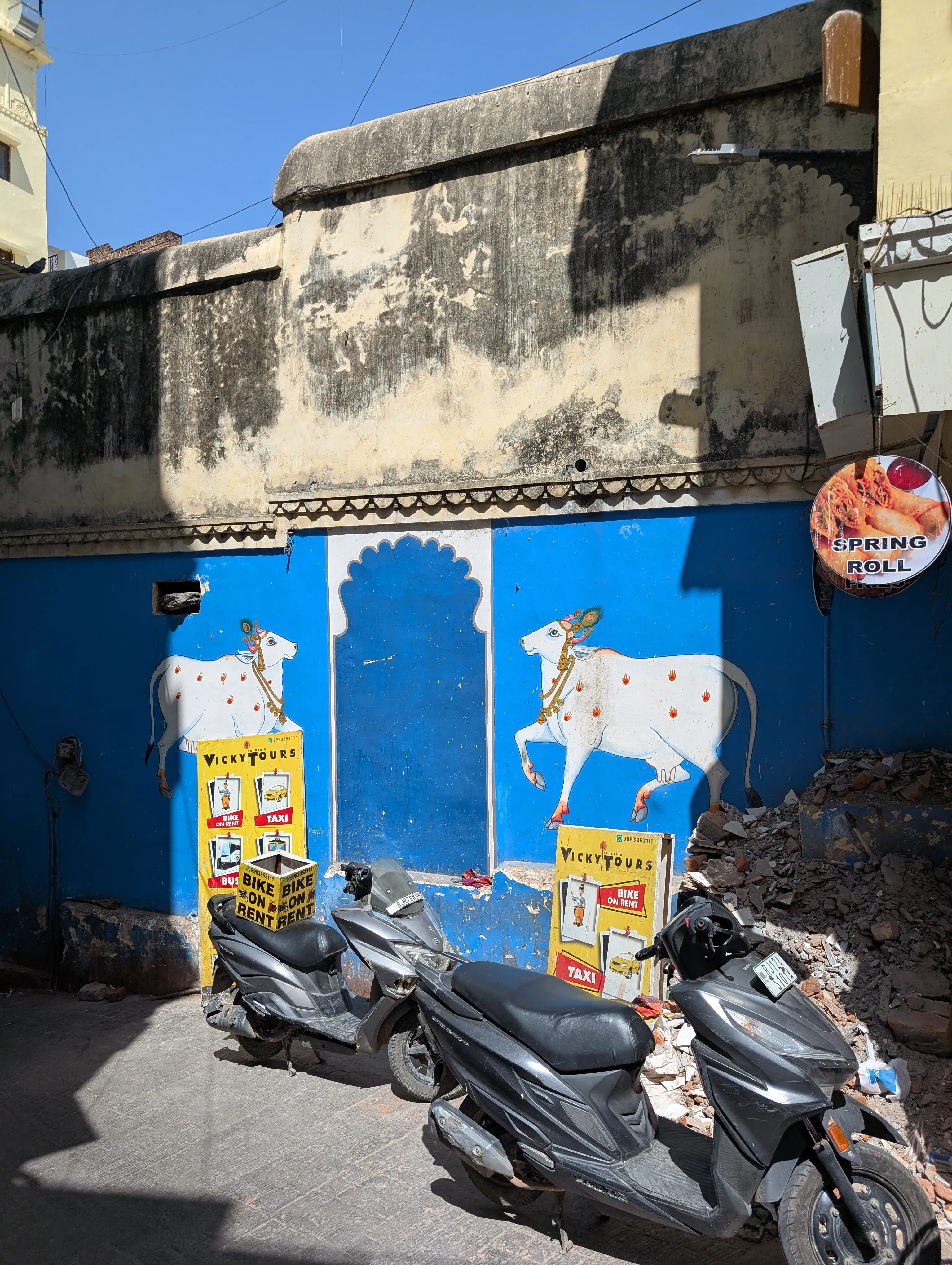
The Hawa Mahal in Jaipur.
4. Bhang Lassi (Makeda)
While ordering dinner in Udaipur, we spotted a menu item we hadn’t seen previously at other restaurants: Special Lassi. When we asked our waiter what it was, he gave us a knowing grin and just said, “flying lassi.” At this point, Paul remembered a buried memory of his sister Emma talking about these special lassis from her time traveling in Rajasthan in 2013, and we pieced together that this was indeed a marijuana-laced iteration of our favorite Indian beverage. I was quick to agree to a little joy ride. We watched as our waiter surreptitiously called his plug, who delivered a backpack within minutes that disappeared into the kitchen and its contents into a blender. While the lassi was appropriately tinged green, it tasted pretty normal otherwise, and the high was gentle and enjoyable, as I was careful to say I wanted a mild experience.
The Hindi word for this drink is Bhang Lassi, and the high comes from the bhang paste, which is made from cannabis leaves and flowers. Most commonly consumed by locals during festivals like Holi, we learned that cannabis has a long history in India in both a religious and medicinal capacity. Religiously, it is associated with Lord Shiva, and sadhus (known to us as holy men or sages) whom we saw many of in Varanasi - use bhang to enhance transcendental meditation and other spiritual practices. In the practice of Ayurveda, with which we brushed most closely in the yoga capital of Rishikesh, cannabis has been used for centuries to treat pain and digestive issues. Though the recreational use of cannabis flower and resin has been criminalized in India since 1985, a legal loophole exists specifically for bhang, hence the relatively easy availability of flying lassis for my happy consumption.
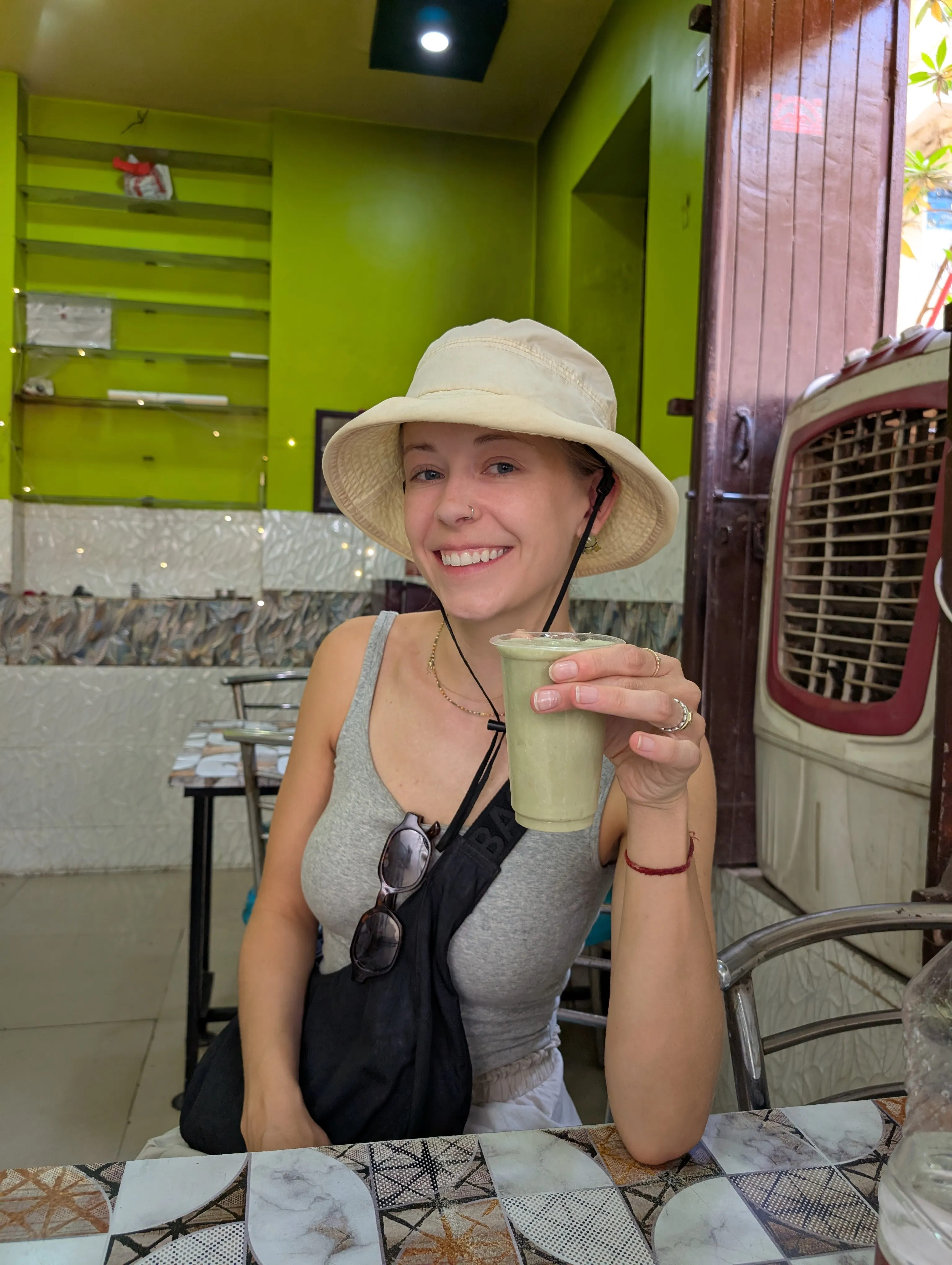 Preparing for takeoff.
5. Intermission in movies (Paul)
In Delhi, Makeda and I saw Project Hail Mary at a movie theater near our hotel. I personally love to see movies while abroad, in part because I just enjoy going to the movies, but also find it fun to discover the quirks and differences of theater-going experiences in other countries. In India, they insert a 10 to 15 minute intermission in movies that do not otherwise have one (like Project Hail Mary). Although initially confusing, this was a pleasant addition to the experience! We could use the restroom without missing anything, refill our snacks, and stretch our legs. The practice comes from Bollywood movies, whose runtimes can exceed four hours. The intermission is written into the screenplay for these movies, but the practice has carried into foreign movies, too. Amaze amaze amaze.
6. Pedestrian hell (Paul)
And now, something we did not love about India. Of all the countries Makeda and I have visted, unfortunately India was the worst place to be a pedestrian, bar none. The issue stems from poor to nonexistent pedestrian infrastructure, aggressive motorists, and weather. The first two are systemic, the third was our fault for traveling in India in late April. In the places we visited there were essentially no sidewalks, and if there were they were dominated by scooter parking, vendor stalls, or sleeping cows. This meant that anyone on foot is forced into the road where hundreds of scooters swarm around interspersed cars and buses, all of which often came close enough to brush an elbow or backpack. We were constantly looking back over our shoulders to check for any incoming near-misses - it was up to us to avoid the car or scooter, not the other way around. Furthermore, we failed to find an alley or side street too narrow for a scooter to attempt to pass. There were places where I could touch either side of the alley without fully extending my arms, and still we would have to flatten ourselves against the wall while a motorcycle zipped by. In hindsight it feels like a minor miracle that neither Makeda nor I had any of our toes run over.
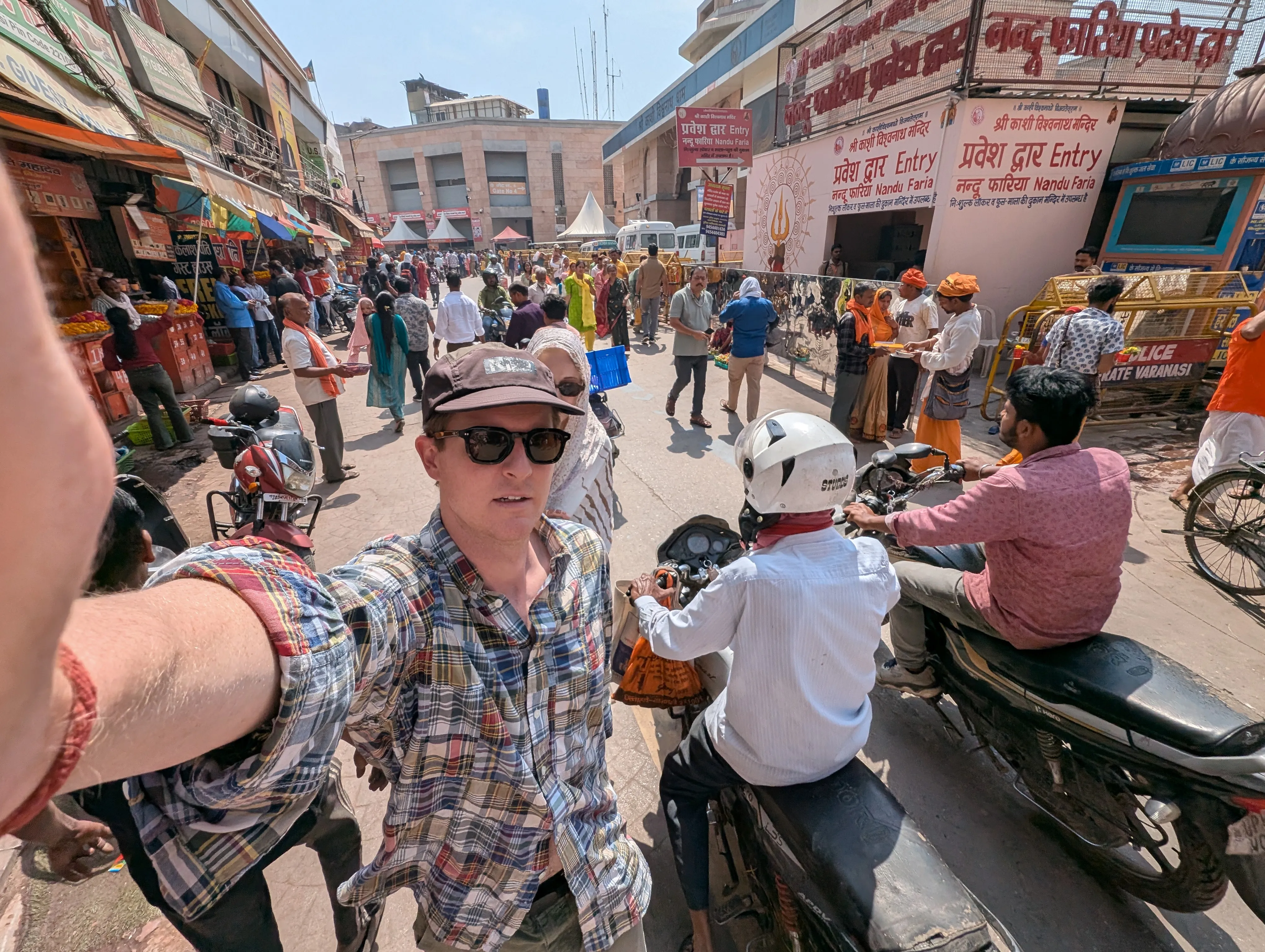 Walking through Varanasi.
To make matters worse, all of this is blanketed by a veritable symphony (or maybe collective agonizing wail) of honking. Personally, the honking was the most challenging aspect of traveling in India, and something that I never got used to. Without exaggeration, every scooter, bus, and car honked every few seconds and very rarely with any discernible purpose. We would see scooters travel an entire city block while blaring their horn with no other vehicle around. We also learned that many people buy aftermarket horns that are louder and more shrill than their stock counterparts. The constant use of the horns collectively renders them all useless and only serves to create a chaotic sonic environment that detracts from an otherwise vibrant and exciting travel destination.
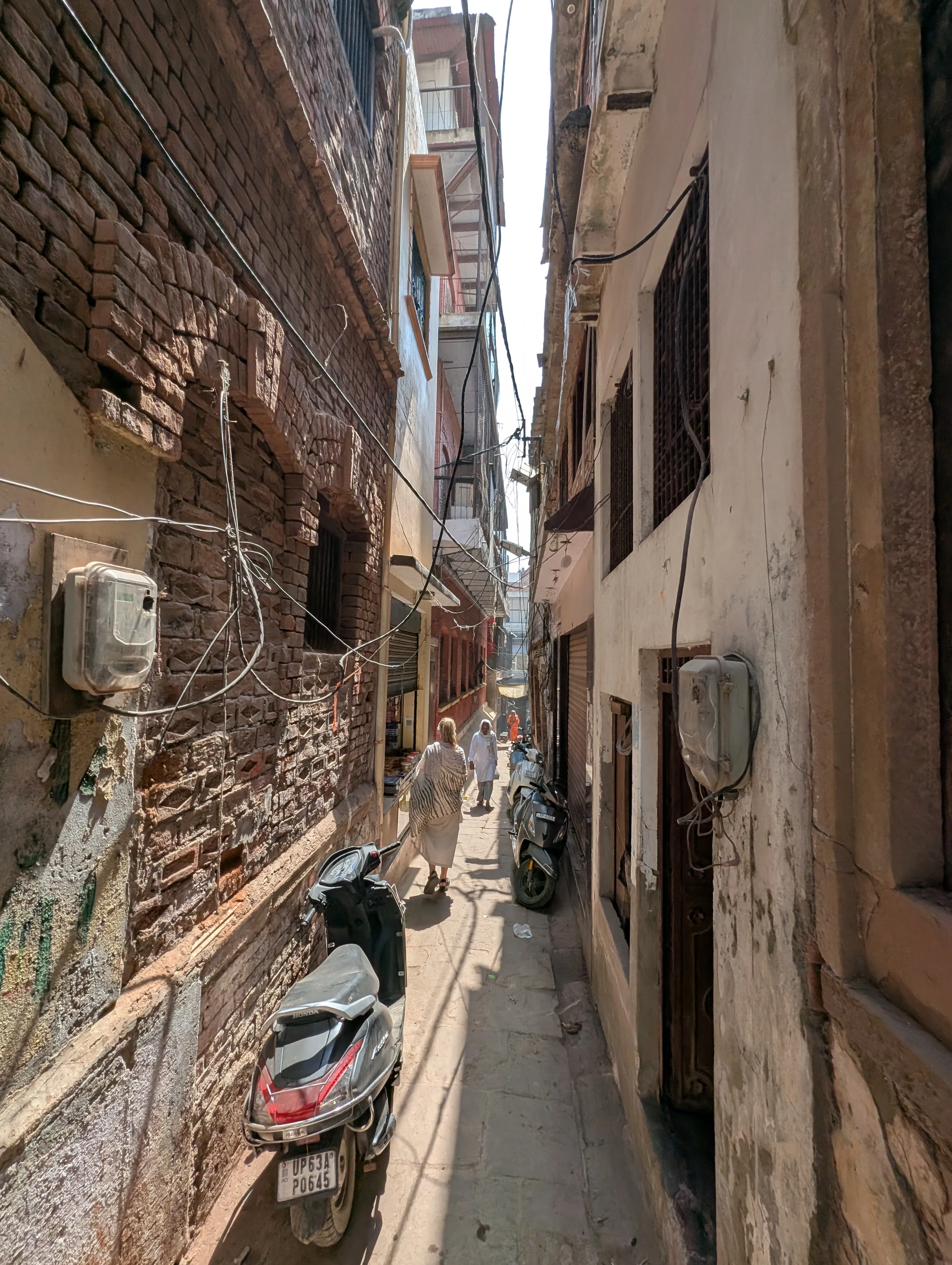 No place too narrow for scooters.
Finally, sidewalk or not, near misses aside; if it is 110 degrees outside it is just not going to be fun to walk around. We had quite pleasant weather for the first two weeks of the trip, but in the back half we rarely had a day under 100 degrees. To mitigate we switched to early morning, late evening excursions with long midday siestas.
This dissatisfaction with pedestrian safety and infrastructure is shared by Indian people as well. Here is an excellent video highlighting some of the progress and roadblocks facing proponents of pedestrian improvements.
7. We’re big in Japan India. (Paul)
Makeda and I, but mostly Makeda, were frequently asked for selfies with strangers. Folks would politely approach, ask for the photo, ask us where we are from (anecdotally, most people we met were still big fans of the U.S.), and then promptly move on. Often a group of teenagers would each ask for a photo one after another, creating the feeling of a meet-and-greet. In a few cases parents of babies or toddlers would pass their child to Makeda to hold during the photo, much to Makeda’s delight. And to my own chagrin there were more than a few times when I would move to join the photo with Makeda and get a bit of a “look” saying that I was not the intended individual for the picture. Ouch. Overall, we thought it was fun and opened the door to some great interactions and conversations.
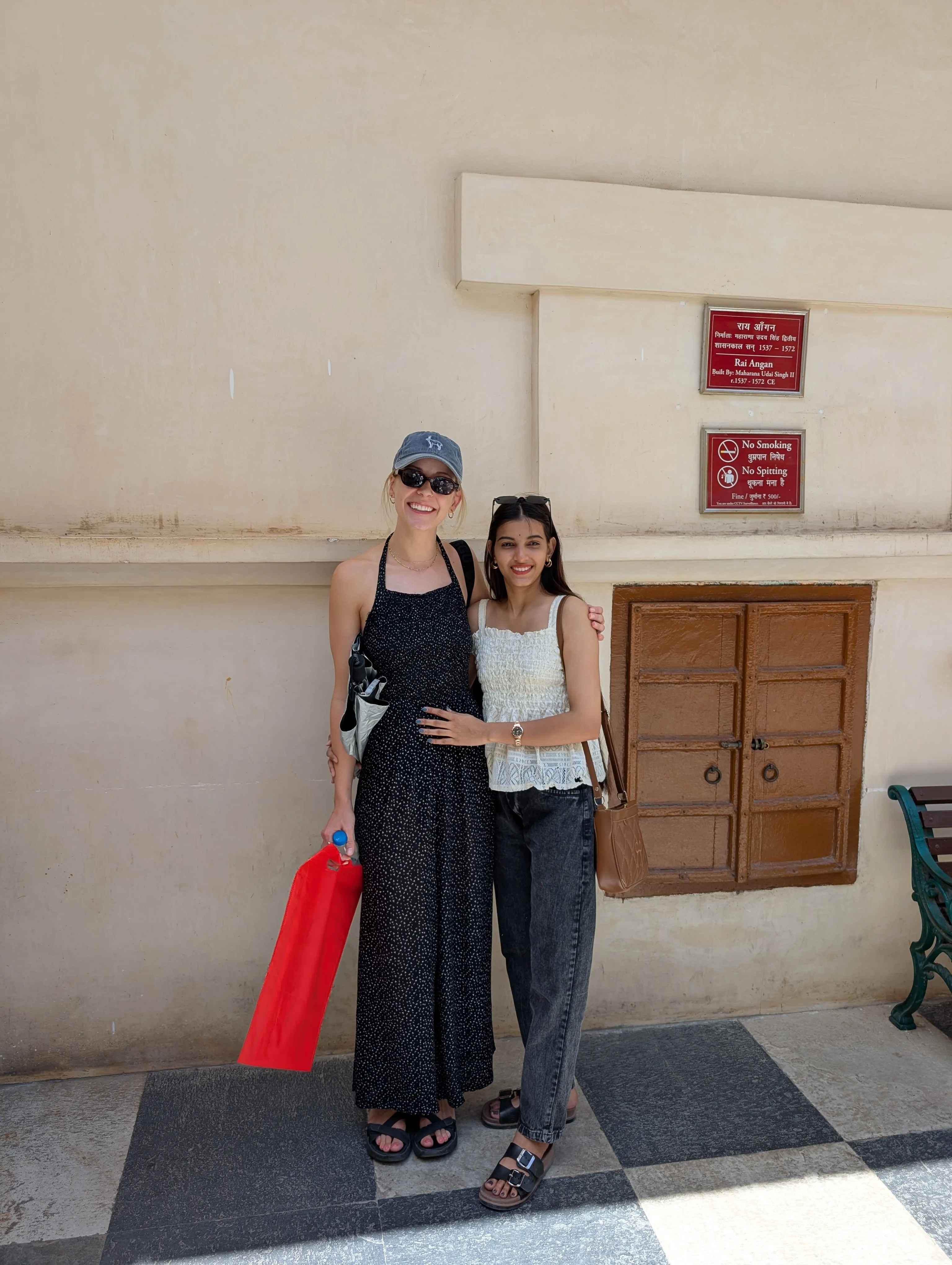
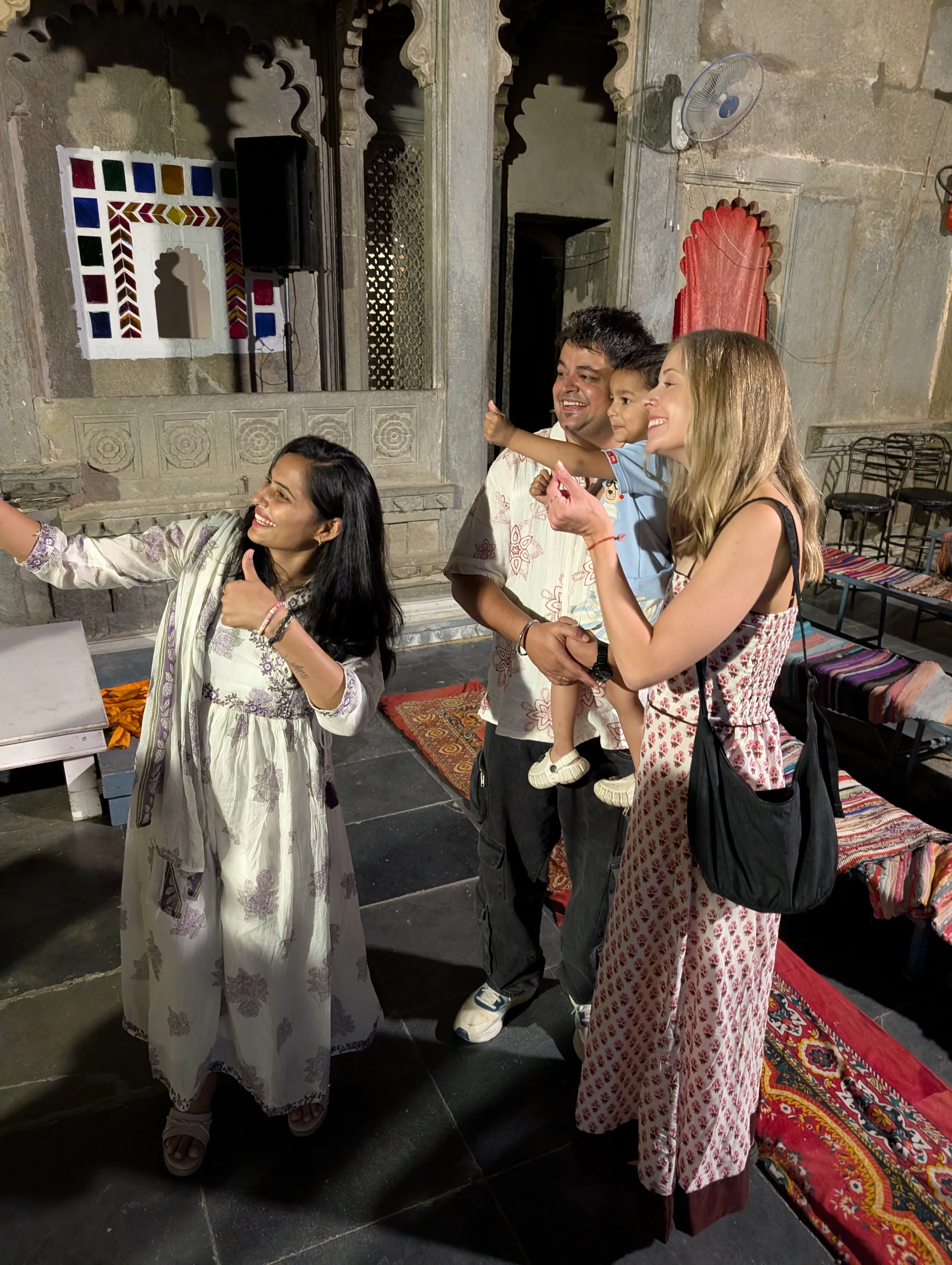
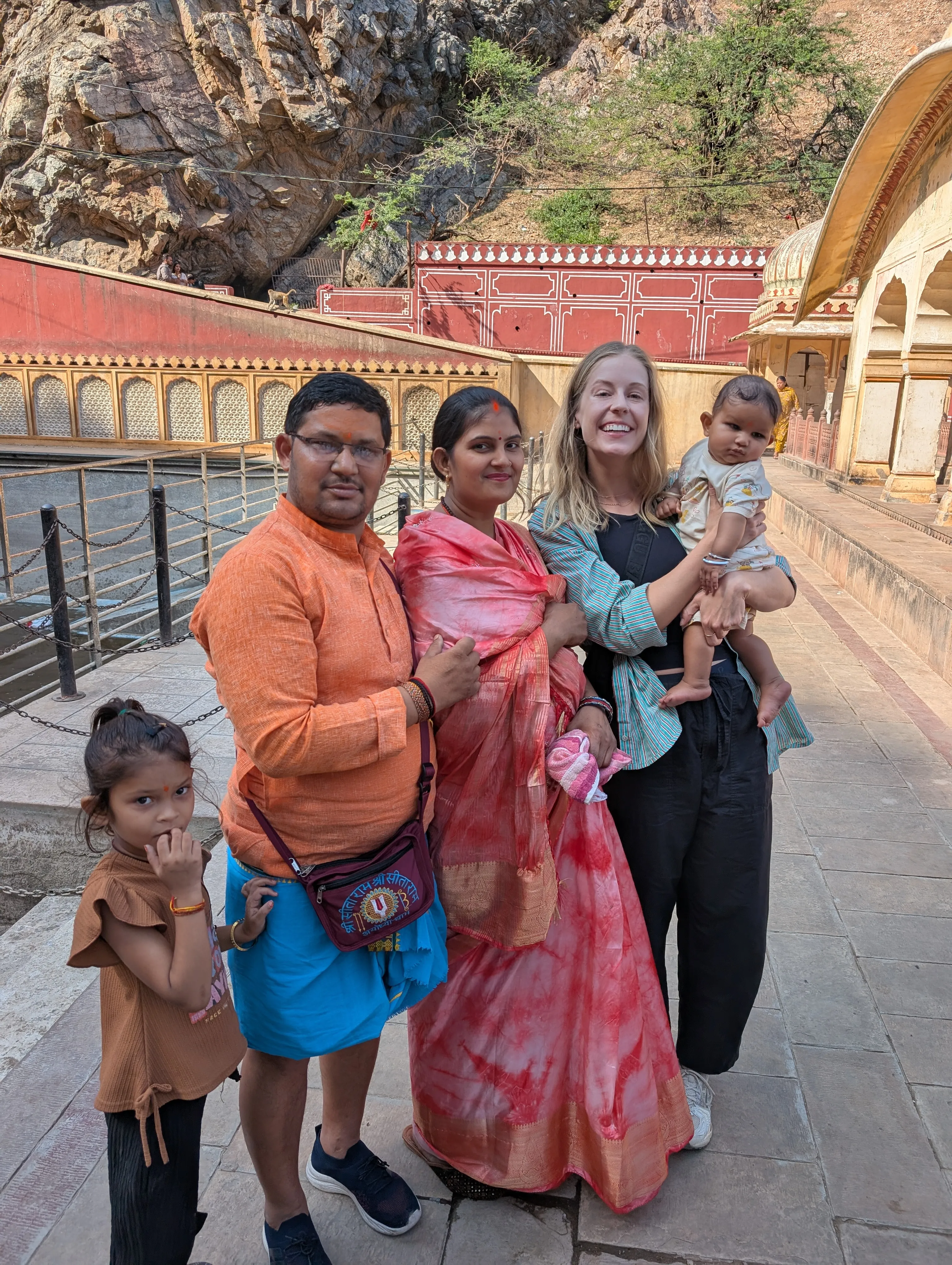
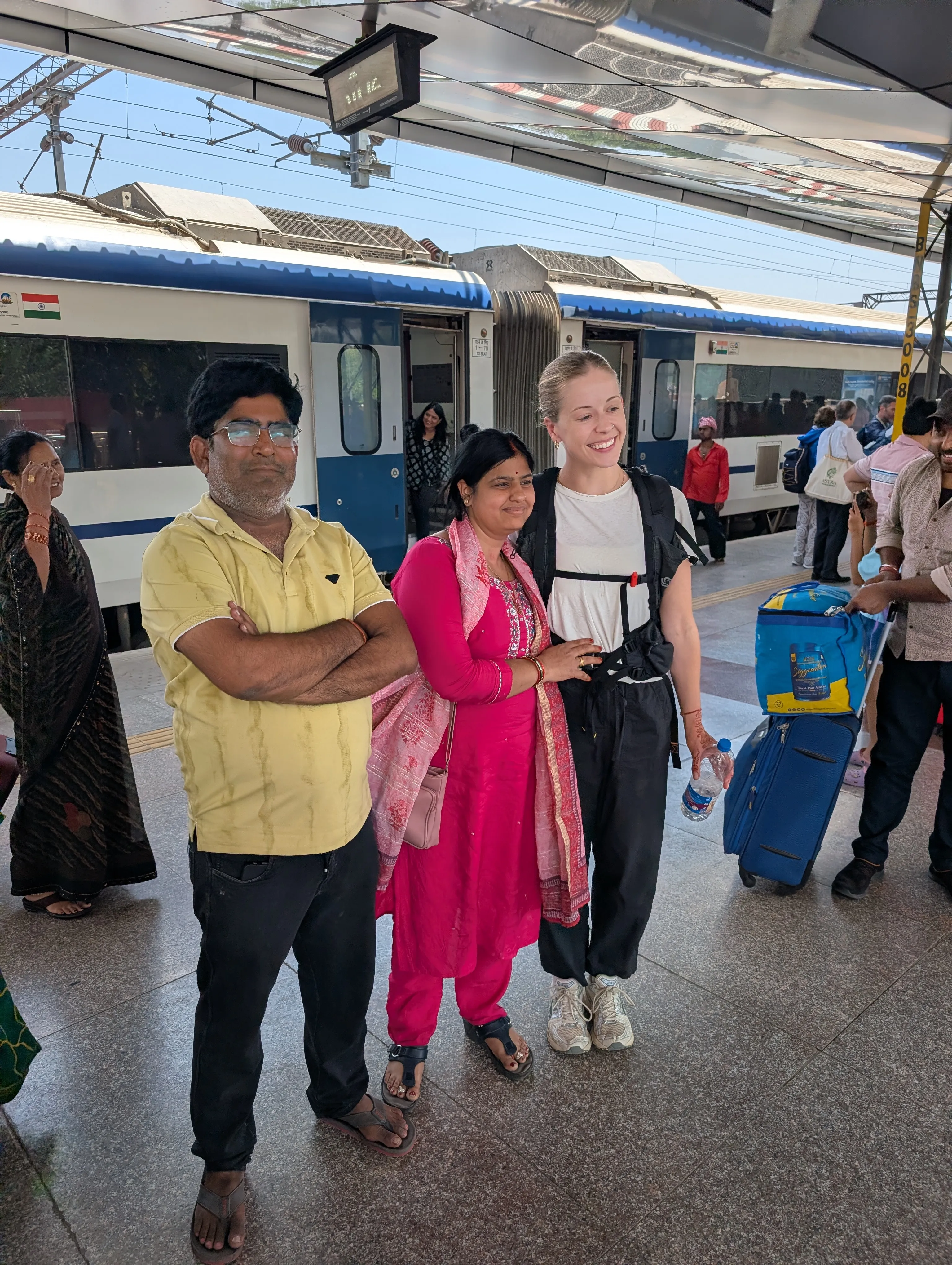
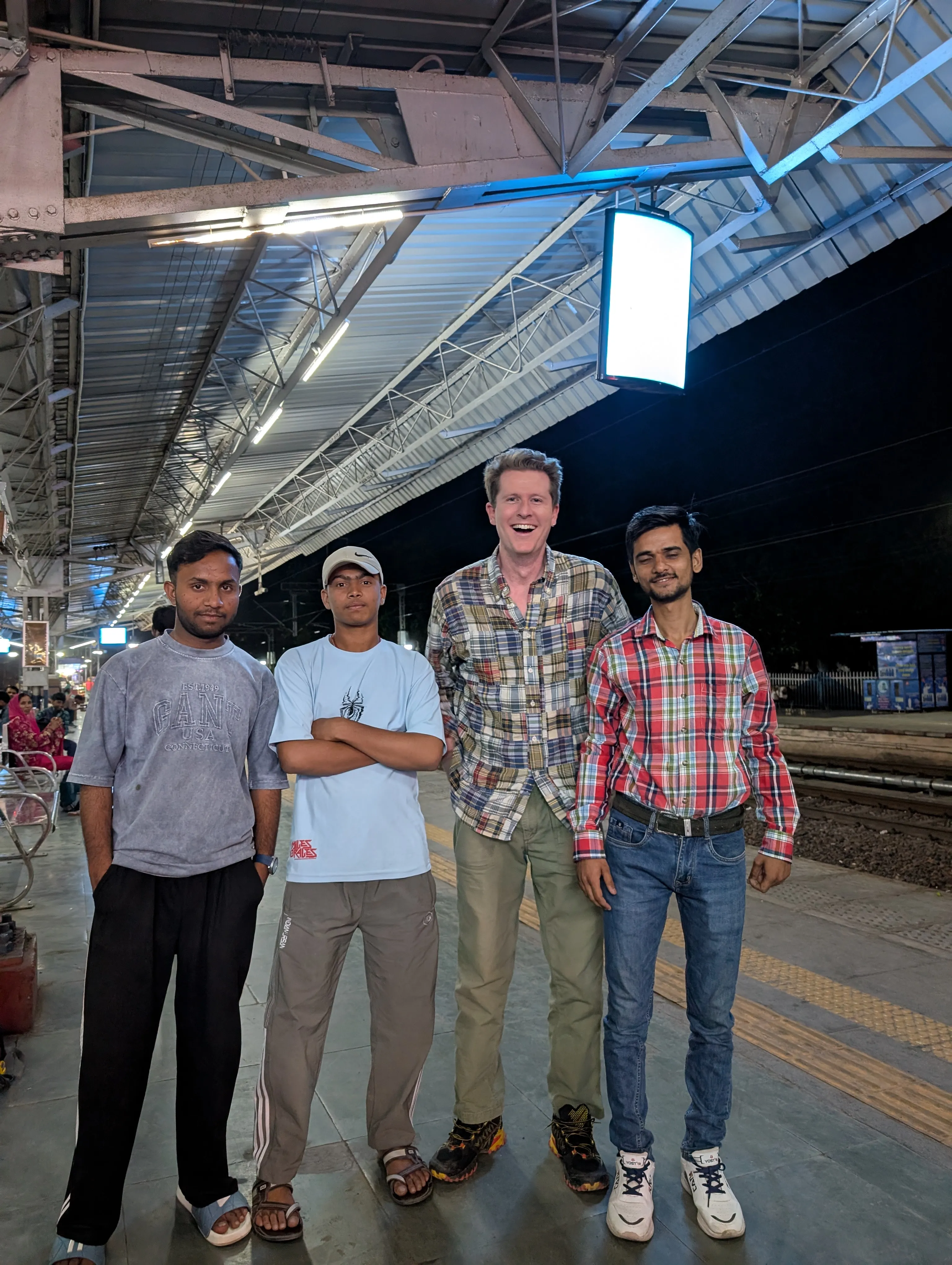
You would think they were old friends.
8. We have an accent? (Paul)
Okay, everyone has an accent. But this has never been more apparent to me than when asking specifically for a water bottle in India. English is an official language in India, and most Indians speak a form of British English, a legacy of colonial rule. We freely conversed with most folks without issue, except when buying or asking for a “water bottle.” We quickly realized that our accent was making those words unintelligble, and only when we spoke in a posh, English accent did people understand our meaning. Never have I felt more like a bucktoothed yokel than repeatedly asking, “wadder bahdal? wadder bahdal?” to a blank stare in what I now realize is my personal American accent.
9. We have to go back! (Makeda)
Despite having the luxury of an entire month to explore India, we still feel like we barely scratched the surface of this country, both geographically and culturally. India is massive, and much like the U.S. it feels impossible to truly understand the country without extensive time visiting the various regions that make up the whole. In India’s case, the large square footage is accompanied by over 100 different major languages, thousands of dialects, and the deep traditions that come along with being one of the world’s oldest civilizations. Top that off with the fact that 1/6th of the world’s population lives in India, and you start to understand how a place can be so full of complexities and contradictions, seemingly unknowable in many ways. By the time we left, I was very ready to go (see above: 100+ degree weather and stomach troubles) but simultaneously filled with excitement to come back someday. At the top of my list are the Kerala backwaters and Bombay (the “NYC of India”). I’m pretty sure I won’t have too hard of a job convincing Paul to come with. ;)